|
|
|
|
|
|
|
|
|
|
JG53 Founded : 1937
Pik-As was a Luftwaffe fighter-wing of World War II. It operated in Western Europe and in the Mediterranean. Jagdgeschwader 53 - or as it was better known, the "Pik As" (Ace of Spades) Geschwader - was one of the oldest German fighter units of World War II with its origins going back to 1937. JG53 flew the various models of Bf-109 throughout the second world war. |
JG53
  Tribute to Franz Schieß by Ivan Berryman. |   Tribute to Alfred Grislawski by Ivan Berryman. |   The Blond Knight by Robert Taylor. |   Bf109 K-4 by Randall Wilson. (GL) |
JG53 Artwork Collection |
  Clipped Signature - Helmut Bennemann. |   Clipped Signature - Helmut Ballewski. | Bf109 K-4 by Randall Wilson. (GL) |
  Angels Three Zero by Robert Taylor |   Special Duties by Robert Taylor. | The Blond Knight by Robert Taylor. |
Tribute to Alfred Grislawski by Ivan Berryman. | Tribute to Franz Schieß by Ivan Berryman. |  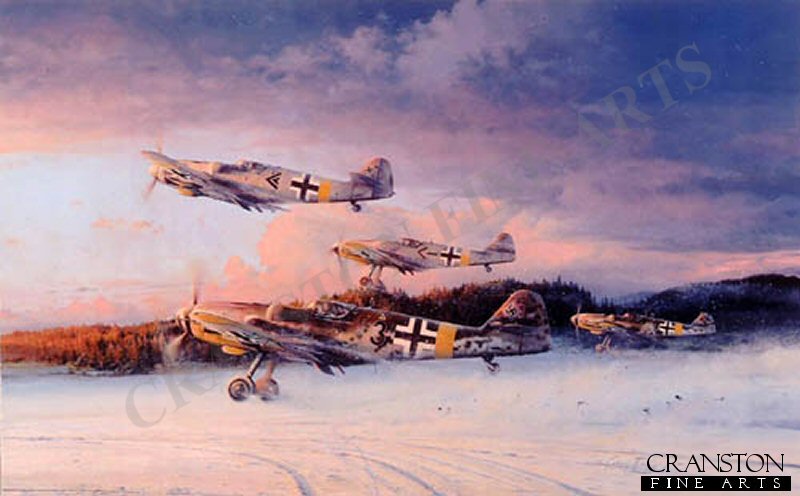 Eagles at Dawn by Robert Taylor. |
  Malta - George Cross by Robert Taylor. |
| Aircraft for : JG53 | |||
| A list of all aircraft known to have been flown by JG53. A profile page including a list of all art prints for the aircraft is available by clicking the aircraft name. | |||
| Squadron | Info | ||

Manufacturer : Messerschmitt Production Began : 1937 Retired : 1945 Number Built : 33984 | Me109 Willy Messerschmitt designed the BF109 during the early 1930s. The Bf109 was one of the first all metal monocoque construction fighters with a closed canopy and retractable undercarriage. The engine of the Me109 was a V12 aero engine which was liquid-cooled. The Bf109 first saw operational service during the Spanish Civil War and flew to the end of World War II, during which time it was the backbone of the Luftwaffe fighter squadrons. During the Battle of Britian the Bf109 was used in the role of an escort fighter, a role for which it was not designed for, and it was also used as a fighter bomber. During the last days of May 1940 Robert Stanford-Tuck, the RAF ace, got the chance to fly an Me109 which they had rebuilt after it had crash landed. Stanford-Tuck found out that the Me109 was a wonderful little plane, it was slightly faster than the Spitfire, but lacked the Spitfire manoeuvrability. By testing the Me109, Tuck could put himself inside the Me109 when fighting them, knowing its weak and strong points. With the introduction of the improved Bf109F in the spring of 1941, the type again proved to be an effective fighter during the invasion of Yugoslavia and during the Battle of Crete and the invasion of Russia and it was used during the Siege of the Mediteranean island of Malta. The Bf109 was the main fighter for the Luftwaffe until 1942 when the Fw190 entered service and shared this position, and was partially replaced in Western Europe, but the Me109 continued to serve on the Eastern Front and during the defence of the Reich against the allied bombers. It was also used to good effect in the Mediterranean and North Africa in support of The Africa Korps. The Me109 was also supplied to several German allies, including Finland, Hungary, Romania, Bulgaria, Croatia, and Slovakia. The Bf109 scored more kills than any other fighter of any country during the war and was built in greater numbers with a total of over 31,000 aircraft being built. The Bf109 was flown by the three top German aces of the war war. Erich Hartmann with 352 victories, Gerhard Barkhorn with 301 victories and Gunther Rall with 275 kills. Bf109 pilots were credited with the destruction of 100 or more enemy aircraft. Thirteen Luftwaffe Aces scored more than 200 kills. Altogether this group of pilots were credited with a total of nearly 15,000 kills, of which the Messerschmitt Bf109 was credited with over 10,000 of these victories. The Bf109 was the most produced warplane during World War II, with 30,573 examples built during the war, and the most produced fighter aircraft in history, with a total of 33,984 units produced up to April 1945. Bf109s remained in foreign service for many years after World War II. The Swiss used their Bf109Gs well into the 1950s. The Finnish Air Force did not retire their Bf109Gs until March 1954. Romania used its Bf109s until 1955. The Spanish Hispanos flew even longer. Some were still in service in the late 1960s. | ||
| Signatures for : JG53 | |||||
| A list of all signatures from our database who are associated with this squadron. A profile page is available by clicking their name. | |||||
| Name | Info | ||||
  Leutnant Helmut Ballewski Click the name or photo above to see prints signed by Leutnant Helmut Ballewski | Leutnant Helmut Ballewski Helmut Ballewski was one of the 'younger' generation flyers, not joining the Luftwaffe until November 1942. Posted to JG53 PIK AS he flew all of his 47 missions in the west. With IV./JG53 from January 1945, Helmut Ballewski was Helmut Bennemann's wingman on Operation Bodenplatte. He also flew fighter bomber operations on the Bridge at Remagen operation. He was awarded the Iron Cross. | ||||
  Oberstleutnant Helmut Bennemann Click the name or photo above to see prints signed by Oberstleutnant Helmut Bennemann
| Oberstleutnant Helmut Bennemann Helmut Bennemann was born 16th March 1915. During the Battle of Britain Helmut Bennemann was Gruppenadjutant with I./JG52 on the Channel Front. In April 1942 he was Staffelkapitan of 3./JG52 in the east and was appointed Kommandeur of I./JG52 from June 1942 until October 1943. Posted to Italy in November 1943, he was promoted to Kommodore of JG53 (Ace of Spades) in this theatre and in the defence of Germany. He commanded JG53 on Operation Bodenplatte. Helmut Bennemann flew over 400 missions, scoring 92 victories and was awarded the Knight's Cross. He died 17th November 2007. | ||||
  Hauptmann Alfred Grislawski Click the name or photo above to see prints signed by or with the mounted signature of Hauptmann Alfred Grislawski
| Hauptmann Alfred Grislawski Alfred Grislawski joined 9./JG52 in 1940, quickly becoming an Ace. An outstanding fighter pilot, his air victories were 133 in over 800 combat missions until he was severely wounded. he was awarded the Knight's Cross with Oak Leaves. Died 19th September 2003. | ||||
 Major Julius Meimberg Click the name or photo above to see prints signed by Major Julius Meimberg
| Major Julius Meimberg Julius Meimberg joined JG2 Richthofen in December 1939 and during the Battle of France flew as wingman to Assi Hahn. An Ace during the Battle of Britain, Meimberg flew with Wick on the day that he was fatally shot down over the Isle of Wight. In 1944 Meimburg was appointed Gruppenkommandeur II./JG53. He was awarded the Knight's Cross and achieved 53 victories in 600 combat missions. Memories from Julius Meimberg of the day that Helmut Wick was shot down : Late in the afternoon of 28th November 1940, we took off for southern England from Beaumont le Roger for our second mission of the day. Climbing towards the Isle of Wight in bright sunshine, I was leading the 4th Staffel and directly ahead of us was the Staff Schwarm of JG2 Richthofen led by Kommodore Major Helmut Wick, at that time the leading fighter pilot in the Luftwaffe. With him were his wingman Oberleutnant Rudi Pflanz, Oberleutnant Leie and Oberfeldwebel Rudorffer. At about 23,000 ft, we were almost above the Isle of Wight when we spotted vapour trails caused by Spitfires above us at a much greater height. Major Wick led his Staff Schwarm towards them at full throttle, with the result that the Schwarm aircraft pulled apart from each other. Climbing with my Staffel to one side, we were soon drawn into the main battle and the Staffel separated. A single Spitfire turned in front of me and disappeared behing my engine cowling as I fired off my weapons. Apparently undamaged, the aircraft went into a spin and I followed it down, expecting the aircraft to pull out at any time, but it never did. The red glow in the cockpit indicated a possible oxygen tank hit. When we landed, Rudi Pflanz reported that Major Wick had shot down a Spitfire, was then in turn shot down by a second Spitfire, which in turn had been shot down by Pflanz. We were all told that no-one had seen what had happened to Wicks aircraft, which left us hoping for the safety of our Kommodore. We returned later next day, and again the following day, but there was no sign of him. What we had not been told was that Rudorffer had witnessed him go down, a large bullet hole passing through the starboard wing trailing edge, straight through the cockpit and engine block. He felt that Wick was already dead as his aircraft corkscrewed downwards, finally plunging into the sea. After the war, I learned that his conqueror had been Flight Lieutenant John Dundas DFC, himself only seconds later shot down by Pflanz and killed. Julius Meimberg passed away on 17th January 2012. | ||||
 Oberst Werner Molders Click the name or photo above to see prints signed by Oberst Werner Molders
| Oberst Werner Molders At the outbreak of WWII Werner Molders was the most successful German fighter pilot, leading 3./JG53, then III.JG53, on the Western Front. As inspirational fighter leader, he was the first Ace to achieve 20 victories, the first awarded the Knights Cross, and commanded JG51 during the Battle of Britain. With 68 victories in the West, he transferred to Russia, and in July 1941 shot down his 101st enemy aircraft, agains as the first to do so. Promoted as the first General of the Fighter Arm, on 22nd November 1941 travelling to the funeral of Ernst Udet, the plane in which he was a passenger crashed and he was killed. Molders had by then achieved 115 victories, and had been awarded the Knights Cross with Oak Leaves and Diamonds. | ||||
 Stabsgefreiter Hubert-Lufwig Pflaum Click the name or photo above to see prints signed by Stabsgefreiter Hubert-Lufwig Pflaum | Stabsgefreiter Hubert-Lufwig Pflaum After joining the Luftwaffe and completing his flight training, he originally flew Heinkel 111 bombers with IV./KG 27 Boelcke. Towards the end of the war, however, he transferred to train as a fighter pilot, and after qualifying joined II./JG53 PikAs where he flew Bf109s with 6 Staffel in the Defence of the Reich. | ||||
  Oberleutnant Gunther Seeger Click the name or photo above to see prints signed by Oberleutnant Gunther Seeger
| Oberleutnant Gunther Seeger In February 1940, Gunther Seeger was an Unteroffizier with 3./JG2, scoring his first victory in the early days of the Battle of Britain. he served on the Channel Front until December 1942, including several months with the Geschwaderstabsschwarm. He transferred to the Mediterranean theatre with II./JG2 before joining 6./JG53. In February 1943 he joined 7./JG53 becoming Staffelkapitan in September 1944. Awarded the Knight's Cross, Gunther Seeger scored 56 victories. | ||||
Major Helmut Wick Click the name above to see prints signed by Major Helmut Wick
| Major Helmut Wick At the outbreak of war Helmut Wick was an experienced Leutnant with 1./JG53. During the Battle of Britain his meteoric rise and remarkable career saw him promoted Staffelkapitan of 3./JG53 in July 1940, Gruppenkommandeur of 1./JG2 on 7th September, achieve his 40th victory on 6th October, and promoted to Kommodore of JG2 on 20th October. With 56 victories to his credit in a period of intense action on the Western Front, on 28th November 1940 he was shot down over the English Channel, parachuted into the sea, but his body was never recovered. Together with Molders and Galland he had been the most successful Luftwaffe fighter pilot during the autumn of 1940, and had been awarded the Knights Cross with Oak Leaves. | ||||
|
Contact Details |
Sign Up To Our Newsletter!
This website is owned by Cranston Fine Arts. Torwood House, Torwoodhill Road, Rhu, Helensburgh, Scotland, G848LE Contact: Tel: (+44) (0) 1436 820269. Email: cranstonorders -at- outlook.com
|
|


