|
|
|
|
|
|
|
|
|
|
JG51 Founded : August 1939
Jagdgeschwader 51 Mölders was a Luftwaffe fighter wing during World War II, named after the fighter ace Werner Mölders in 1942. JG 51's pilots won more Ritterkreuz des Eisernen Kreuzes than any other Jagdgeschwader, and flew combat from 1939 in all major theatres of war. Flying Bf 109s and then FW 190s, the wing claimed over 8,000 air victories. Experten included 'Toni' Hafner, Heinz Bär, Richard Leppla, Karl-Gottfried Nordmann, Günther Schack and the legendary Mölders. |
JG51
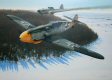  Anton Hafner by Ivan Berryman. (PC) |   Valiant Response by Robert Taylor. |   Air Armada by Robert Taylor. |   Open Assault by Robert Taylor. |
JG51 Artwork Collection |
  Clipped Signature - Heinz Radlauer. |   Clipped Signature - Heinz Marquardt. | Open Assault by Robert Taylor. |
  Anton Hafner by Ivan Berryman. | Air Armada by Robert Taylor. | Valiant Response by Robert Taylor. |
| Aircraft for : JG51 | |||
| A list of all aircraft known to have been flown by JG51. A profile page including a list of all art prints for the aircraft is available by clicking the aircraft name. | |||
| Squadron | Info | ||

Manufacturer : Fokke-Wulf Production Began : 1940 Retired : 1945 | Fw190 The Focke-Wulf 190 development project began in 1937. Conceived as a hedge against total dependence on the Messerchmitt 109, the 190 was designed by Kurt Tank utilizing a radial engine. This was against generally accepted design criteria in Germany, and many historians believe that the decision to produce a radial engine fighter was largely due to the limited manufacturing capacity for in-line, water-cooled engines which were widely used on all other Luftwaffe aircraft. Despite these concerns, Tanks design was brilliant, and the 190 would become one of the top fighter aircraft of WWII. The first prototype flew in mid-1939. The aircraft had excellent flying characteristics, a wonderful rate of acceleration, and was heavily armed. By late 1940 the new fighter was ordered into production. Nicknamed the butcher bird, by Luftwaffe pilots, early 190s were quite successful in the bomber interceptor role, but at this stage of the war many Allied bombing raids lacked fighter escort. As the war dragged on, Allied bombers were increasingly accompanied by fighters, including the very effective P-51 Mustang. The Allies learned from experience that the 190s performance fell off sharply at altitudes above 20,000 feet. As a result, most Allied bombing missions were shifted to higher altitudes when fighter opposition was likely. Kurt Tank had recognized this shortcoming and began working on a high-altitude version of the 190 utilizing an in-line, water-cooled engine. Utilizing a Jumo 12-cylinder engine rated at 1770-HP, and capable of 2,240-HP for short bursts with its methanol injection system, the 190D, or Long Nose or Dora as it was called, had a top speed of 426-MPH at 22,000 feet. Armament was improved with two fuselage and two wing mounted 20mm cannon. To accommodate the changes in power plants the Dora had a longer, more streamlined fuselage, with 24 inches added to the nose, and an additional 19 inches added aft of the cockpit to compensate for the altered center of gravity. By mid 1944 the Dora began to reach fighter squadrons in quantity. Although the aircraft had all the right attributes to serve admirably in the high altitude interceptor role, it was not generally focused on such missions. Instead many 190Ds were assigned to protect airfields where Me-262 jet fighters were based. This was due to the latter aircrafts extreme vulnerability to Allied attack during takeoff and landing. The 190Ds also played a major role in Operation Bodenplatte, the New Years Day raid in 1945 which destroyed approximately 500 Allied aircraft on the ground. The High Command was impressed with the 190Ds record on this raid, and ordered most future production of the Doras to be equipped as fighter-bombers. In retrospect this was a strategic error, and this capable aircraft was not fully utilized in the role for which it was intended. | ||

Manufacturer : Messerschmitt Production Began : 1937 Retired : 1945 Number Built : 33984 | Me109 Willy Messerschmitt designed the BF109 during the early 1930s. The Bf109 was one of the first all metal monocoque construction fighters with a closed canopy and retractable undercarriage. The engine of the Me109 was a V12 aero engine which was liquid-cooled. The Bf109 first saw operational service during the Spanish Civil War and flew to the end of World War II, during which time it was the backbone of the Luftwaffe fighter squadrons. During the Battle of Britian the Bf109 was used in the role of an escort fighter, a role for which it was not designed for, and it was also used as a fighter bomber. During the last days of May 1940 Robert Stanford-Tuck, the RAF ace, got the chance to fly an Me109 which they had rebuilt after it had crash landed. Stanford-Tuck found out that the Me109 was a wonderful little plane, it was slightly faster than the Spitfire, but lacked the Spitfire manoeuvrability. By testing the Me109, Tuck could put himself inside the Me109 when fighting them, knowing its weak and strong points. With the introduction of the improved Bf109F in the spring of 1941, the type again proved to be an effective fighter during the invasion of Yugoslavia and during the Battle of Crete and the invasion of Russia and it was used during the Siege of the Mediteranean island of Malta. The Bf109 was the main fighter for the Luftwaffe until 1942 when the Fw190 entered service and shared this position, and was partially replaced in Western Europe, but the Me109 continued to serve on the Eastern Front and during the defence of the Reich against the allied bombers. It was also used to good effect in the Mediterranean and North Africa in support of The Africa Korps. The Me109 was also supplied to several German allies, including Finland, Hungary, Romania, Bulgaria, Croatia, and Slovakia. The Bf109 scored more kills than any other fighter of any country during the war and was built in greater numbers with a total of over 31,000 aircraft being built. The Bf109 was flown by the three top German aces of the war war. Erich Hartmann with 352 victories, Gerhard Barkhorn with 301 victories and Gunther Rall with 275 kills. Bf109 pilots were credited with the destruction of 100 or more enemy aircraft. Thirteen Luftwaffe Aces scored more than 200 kills. Altogether this group of pilots were credited with a total of nearly 15,000 kills, of which the Messerschmitt Bf109 was credited with over 10,000 of these victories. The Bf109 was the most produced warplane during World War II, with 30,573 examples built during the war, and the most produced fighter aircraft in history, with a total of 33,984 units produced up to April 1945. Bf109s remained in foreign service for many years after World War II. The Swiss used their Bf109Gs well into the 1950s. The Finnish Air Force did not retire their Bf109Gs until March 1954. Romania used its Bf109s until 1955. The Spanish Hispanos flew even longer. Some were still in service in the late 1960s. | ||
| Signatures for : JG51 | |||||||||
| A list of all signatures from our database who are associated with this squadron. A profile page is available by clicking their name. | |||||||||
| Name | Info | ||||||||
 Heinz Bar Click the name or photo above to see prints signed by Heinz Bar
| Heinz Bar Lieutenant Colonel Oskar-Heinz Heinrich Pritzl Bär born 25 May 1913 was a German Luftwaffe flying ace who served throughout World War II in Europe. A flying ace or fighter ace is a military aviator credited with shooting down five or more enemy aircraft during aerial combat. He flew over a thousand combat missions, and fought in all major German theatres of the war, including the Western, Eastern and Mediterranean fronts. On 18 occasions he survived being shot down, and he was credited with 220 aerial victories. Heinz Bär, a Saxon with a strong accent, joined the Reichswehr in 1934 and transferred to the Luftwaffe in 1935. Serving first as a mechanic, then as a pilot on transport aircraft, he was informally trained as a fighter pilot. He claimed his first aerial victory in September 1939 on the French border. By the end of the Battle of Britain, his tally of victories had increased to 17. Transferred to the Eastern front to participate in Operation Barbarossa, he quickly accumulated further victories, a feat that earned him the Knight's Cross of the Iron Cross with Oak Leaves and Swords for 90 aerial victories in February 1942. During the remainder of World War II, Heinz Bär was credited with 130 other aerial victories, including 16 while flying one of the first jet fighters, the Me 262, an achievement which would normally have earned him the coveted Knight's Cross of the Iron Cross with Oak Leaves, Swords and Diamonds However, Hermann Göring's personal dislike of Bär, coupled with Bär's insubordinate character and lack of military discipline, deprived him of this award. After World War II, Bär continued his career as an aviator and was killed in a flying accident on 28 April 1957 near Braunschweig. | ||||||||
 Franz-Josef Beerenbrock Click the name or photo above to see prints signed by Franz-Josef Beerenbrock
| Franz-Josef Beerenbrock Born in 1920, Franz-Josef Beerenbrock trained as a pilot in 1939, joining JG51 on the eastern front in March 1941. With 46 victories, he was awarded the Knights Cross on 6th October 1941. By the beginning of August 1942, he was the most successful pilot in JG51, with a total of 102 victories. However, he was himself shot down on 9th November 1943, and was captured. With a final score of 117 victories, he was not repatriated until 1949. Sadly, he died on 13th December 2004. | ||||||||
  Major Hans-Ekkehard Bob Click the name or photo above to see prints signed by or with the mounted signature of Major Hans-Ekkehard Bob
| Major Hans-Ekkehard Bob After success in the Battle of Britain, Hans-Ekkehard Bob took over leadership of 9./JG54 in 1940. The following year he was awarded the Knights Cross. Transferring to the Eastern Front his victories rose steadily to 50 by September 1942. His Group later transferred back to the West for a short period, where in April 1943, he rammed a B-17 Fortress. Returning to the Eastern Front as Kommander of IV./JG3, he ended the war as Adjutant of Gallands JV44 in the West. In his 700 missions he scored 60 victories.
| ||||||||
 Adolf Borchers Click the name or photo above to see prints signed by or with the mounted signature of Adolf Borchers
| Adolf Borchers Adolf Borchers was born on 10th February 1913 in Wendhausen near Lunesburg. In the autumn of 1938 he was in the Legion Condor. He was transferred to JG51 where he flew in the Polish and Western campaign and in the Battle of Britain, during which he scored five victories. By the end of 1941 his score stood at 23. In October 1942 he was promoted to Officer and named squadron leader of 11./JG51. By the end of 1942 his score stood at 38. On 7th May 1943 he scored his 44th to 49th victories. A short time later he was awarded the Knights Cross for 78 victories. He was then neamd Commander of 1./JG52 on 11th June 1944 and on 24th July that year he scored his 110th victory. His 118th victory came on 2nd September, the same time the 10,000th victory of JG52 was recorded. Erci hHartmann took over 1./JG52 on 1st February 1945 and Borchers was appointed Commander of iii./JG52. He was bitterly disappointed at being replaced by this youngster and carried that resentment to the grave. Borchers flew approximately 800 missions and had 132 victories, including 5 in the west. He was the 53rd ranking ace in Germany. Adolf Borchers died 9th February 1996. | ||||||||
  Feldwebel Erich Brunotte Click the name or photo above to see prints signed by Feldwebel Erich Brunotte | Feldwebel Erich Brunotte Born in 1923, Erich Brunotte joined the Luftwaffe and started immediate pilot training in June 1941. He flew on the Eastern Front with 1./Gruppe Nauhaufklarungs Geschwader 102, and later transferred to fly with IV./Jagdgeswader 51 Molders, in the 13th Staffel. Promoted to Unteroffizier in December 1944, and Feldwebel in April 1945, he flew most marks of the Bf109, and the Fw190. His very last combat mission was in the Fw Dora 9 on 3rd May 1945 at Flensburg in northen Germany. | ||||||||
  Hermann Graf Click the name or photo above to see prints signed by or with the mounted signature of Hermann Graf
| Hermann Graf Hermann Graf, born in October 1912, trained to be a pilot from 1936, and in the summer of 1939 joined 2./JG51. With 9./JG52, Graf was transferred around several European stations, including Greece and Romania, eventually transferring to the Ukraine in August 1941. Claiming his first victory in August 1941, by early 1942 he had scored 45 victories, earning him the Knights Cross on 24th January 1942. Rapidly adding to his victories on the eastern front, Hermann Graf became the first pilot to score over 200 victories, earning the Oak Leaves, Sword and Diamonds to his Knights Cross on 17th May, 19th May and 16th September 1942 respectively. Due to the potential morale loss should such a high scoring Ace be shot down, he was subsequently moved to command a pilot training unit. He was injured after a collision with an American fighter in March 1944, recovering to take command of JG52 once again. finally surrendering his unit in May 1945. His total was 212 victories. Hermann Graf died 11th April 1988. | ||||||||
  Major Heinz Lange Click the name or photo above to see prints signed by or with the mounted signature of Major Heinz Lange
| Major Heinz Lange At the outbreak of war Heinz Lange was with I./JG21 scoring his first victory in October 1939. He flew 76 missions in the Battle of Britain with 8./JG54, and never lost a wingman. After flying in the Balkan campaign he took part in the invasion of Russia, scoring 7 victories during the first week. In October 1941 he was given command of 1./JG54 and in 1942 command of 3./JG51. In January 1944 Heinz Lange returned to JG54 to command 1.Gruppe and then back to JG51 where he was appointed Kommodore of JG51 Molders, leading IV./JG51 at the same time. Heinz Lange flew over 628 missions and achieved 70 victories. He was awarded the Knight's Cross. Born 2nd October 1917, died 26th February 2006.
| ||||||||
  Oberfeldwebel Heinz Marquardt Click the name or photo above to see prints signed by or with the mounted signature of Oberfeldwebel Heinz Marquardt
| Oberfeldwebel Heinz Marquardt In late 1941 Heinz Marquardt was with a training squadron south of Paris. In August 1943 he was posted to join IV./JG51 in Russia, achieving his first victory two months later. Shot down eight times, he once achieved twelve victories in a single day. Awarded the Knight's Cross in November 1944, he flew a total of 320 missions, and scored 121 victories. Sadly, Heinz Marquardt died 19th December 2003, aged 80.
| ||||||||
 Oberst Werner Molders Click the name or photo above to see prints signed by Oberst Werner Molders
| Oberst Werner Molders At the outbreak of WWII Werner Molders was the most successful German fighter pilot, leading 3./JG53, then III.JG53, on the Western Front. As inspirational fighter leader, he was the first Ace to achieve 20 victories, the first awarded the Knights Cross, and commanded JG51 during the Battle of Britain. With 68 victories in the West, he transferred to Russia, and in July 1941 shot down his 101st enemy aircraft, agains as the first to do so. Promoted as the first General of the Fighter Arm, on 22nd November 1941 travelling to the funeral of Ernst Udet, the plane in which he was a passenger crashed and he was killed. Molders had by then achieved 115 victories, and had been awarded the Knights Cross with Oak Leaves and Diamonds. | ||||||||
  Unteroffizier Johannes Oesterhelt Click the name or photo above to see prints signed by Unteroffizier Johannes Oesterhelt | Unteroffizier Johannes Oesterhelt Born in August 1925, Johannes Oesterhelt joined the Luftwaffe in July 1943 and was one of the youngest pilots to fly with JG51 Molders. Joining IV./JG51 he flew his first combat mission in January 1945, aged 19, flying with the 13th Staffel against the advancing Russians in the area around the northern city of Danzig, and protecting the retreating German army. He flew against Russian II-2s, Yak-3s, Airacobras, and also against Russian tanks. He scored 2 confirmed air victories before the war ended. | ||||||||
  Feldwebel Heinz Radlauer Click the name or photo above to see prints signed by Feldwebel Heinz Radlauer | Feldwebel Heinz Radlauer Heinz Radlauer learnt to fly gliders in 1940, aged 17, and joined the Luftwaffe in August 1941. After Fighter School, in June 1944 he was posted to join JG51 Molders then fighting on the Eastern Front near Minsk, scoring his first victory in October of that year. Heinz Radlauer fleew the Bf109G, the Fw190A, and at the end of the war the Fw190D, by which time he had notched up over 100 combat missions, flying his last combat mission on 30th April 1945. Credited with 15 air victories, all on the Eastern Front, he was awarded the Iron Cross 1st and 2nd Class. | ||||||||
 Oberfeldwebel Helmut Ruffler Click the name or photo above to see prints signed by Oberfeldwebel Helmut Ruffler
| Oberfeldwebel Helmut Ruffler Helmut Ruffler joined 9./JG3 in February 1941 and was soon to prove himself a masterful fighter pilot. His scores began to mount quickly and by the end of 1942 his tally had risen to 50 victories. Surviving being shot down in 1943, he was posted as a much needed fighter instructor but was soon back in the fray - joining 4./JG3 in the home defence of the Reich. In March 1945 he was promoted Staffelfuhrer of 9./JG51. Shot down 5 times during the war, Helmut Ruffler fleww over 690 missions and scored 98 victories. He was awarded the Knight's Cross in December 1942. He died on 21st September 2001. | ||||||||
  Captain Gunther Schack Click the name or photo above to see prints signed by or with the mounted signature of Captain Gunther Schack
| Captain Gunther Schack Major Günther Schack was born in Bartenstein, a small town in Eastern Prussia, on 12 November 1917 as the son of Dr. Willy Schack and his wife, Dorothea (maiden name: Nietzki). He studied at the University of Stuttgart and at the Rheinisch-Westfälische Technische Hochschule. In 1937, when he first tried to join the Luftwaffe, he was categorised as wehruntauglich (unsuited for military service) because of a sports injury earlier in his life. Günther Schack resubmitted an application as a volunteer and was accepted into the Luftwaffe on 2 September 1939. After being trained as a fighter pilot, Schack was posted to 7th Staffel of Jagdgeschwader 51. Schack claimed first aerial victory in combat on 23 July 1941 on the Eastern front. Meanwhile, he had been promoted to the rank of Unteroffizier. After his 48th aerial victory, he was ordered back to Germany to serve as a flight instructor and was promoted to Leutnant on 1 January 1943. In mid 1943 he returned back to the Eastern front, now serving in the 9th Staffel of JG 51. He claimed his century mark in aerial combat on 3 September 1943. On 8 December 1943 he was made Staffelkapitän of 9./JG 51. Leutnant Günther Schack was awarded the Oak Leaves to his Knight's Cross of the Iron Cross on 20 April 1944 for 133 aerial victories.[2] Schack was then promoted to Hauptmann on 1 July 1944. In December 1944, now a Gruppenkommandeur, in charge of I./JG 51. After this Gruppe was disbanded on 1 May 1945 he briefly was named commander of the 4th Gruppe of Jagdgeschwader 3. By the end of the war, he had scored 174 victories in 780 aerial combats, and was shot down 15 times. Günther Schack died 14 June 2003 in Schmidt near Nideggen he was a German World War II fighter ace who served in the Luftwaffe from 1939 until the end of World War II in 1945. He claimed 174 enemy aircraft shot down, all of them on the Russian front. He survived being shot down 15 times during his 780 combat missions. After the war he lived secluded in the Eifel Mountains, and devoted himself to philosophical research. | ||||||||
Unteroffizier Friedrich Schelker Click the name above to see prints signed by Unteroffizier Friedrich Schelker
| Unteroffizier Friedrich Schelker Joining the Luftwaffe in the autumn of 1940, Friedrich Schelker was posted to I./JG52 at Dnepropetrowsk a year later, flying the Me109F. Later when serving with 7./JG51 in the southern sector of Mariupol he was shot down and badly wounded. After hospitalisation, in 1943 he was transferred to fly the Fischler Fil56 Storch. Friedrich served throughout the Eastern Front, in Russia, Rumania and Hungary. He scored 22 victories and was awarded the Iron Cross 1st and 2nd Class. | ||||||||
  Major Gerhard Schopfel Click the name or photo above to see prints signed by or with the mounted signature of Major Gerhard Schopfel
| Major Gerhard Schopfel Gerhard Schopfel was Staffelkapitan of 9./JG26 at the outbreak of war, and became Kommandeur of III./JG26 in August 1940. In December 1941 he succeeded Adolf Galland as Kommodore of JG26 until Januray 1943. Later, Kommodore of JG4 and JG6. He flew over 700 combat missions, achieving 40 victories, all in the West. He was awarded the Knight's Cross in 1940. Died 17th May 2003.
| ||||||||
Hauptmann Otto Schultz Click the name above to see prints signed by Hauptmann Otto Schultz | Hauptmann Otto Schultz Otto Schultz flew with II /JG 51 Mölders during the Battle of Britain. He moved to the Eastern Front and gained his first victory on the 22 June 1941. As well as flying missions on the Russian front he also flew missions against Tunisia, Italy, Romania and Hungary. He was awarded his Knights Cross on the 14 March 1943 while at the rank of Oberfeldwebel with 51 victories. He scored 20 victories in Tunisia and went on to become Staffelkapitän of 6/JG 51. Schultz was a very accomplished fighter pilot and often referred to as one of the Luftwaffes fighter experts who on account of their ability and experience managed to survive the entire war completing a vast number of missions. Total of 73 victories, 40 of which scored on the Eastern Front and 8 four engined bombers. Over 800 missions. | ||||||||
 Oberleutnant Kurt Schulze Click the name or photo above to see prints signed by Oberleutnant Kurt Schulze | Oberleutnant Kurt Schulze After serving with the Air Signals Corps during the Blitzkrieg through the Low Countries and France, Kurt Schulze then flew as a Me110 Wireless Operator over southern Russia, before returning to the west. Here he flew night missions against England in Do217s with I./KG2. In September 1943 he transferred to train as a fighter pilot, and flew 65 missions in Me109s with III./JG5 on the Arctic Front, scoring three victories. In November 1944 he flew in the ill-fated defence of the German battleship Tirpitz. In March 1945 he commanded I./JG51 in the encircled east German city of Danzig, before returning to Norway in May 1945 to command 16./JG5. | ||||||||
  Hannes Trautloft Click the name or photo above to see prints signed by or with the mounted signature of Hannes Trautloft
| Hannes Trautloft Hannes Trautloft is one of the Luftwaffe's great fighter leaders, scoring his first air victory in the Spanish Civil War in August 1936. Returning to Germany in 1937 he joined the national aerobatics team flying the Me109. Soon after the outbreak of World War II, Hannes took command of I./JG20 taking part in the Battle of Britain, before moving to the Balkans as Kommodore of JG54. Now leading the group on the Russian Front, JG54 took part in the heavy fighting, first in the Me109, then the Fw190. In the summer of 1943 Hannes Trautloft joined General Galland's staff. As a 'mutineer' he was sacked by Goering, thus ending an illustrious combat career comprising 550 combat missions and 57 aerial victories. he died 11th January 1995. | ||||||||
  General Herbert Wehnelt Click the name or photo above to see prints signed by General Herbert Wehnelt
| General Herbert Wehnelt Joining the Luftwaffe in 1936, Herbert Wehnelt served first with 2./JG132 Richthofen. During the Battle of Britain he flew with III./JG51 and served in the West until transferring to the Eastern Front in 1943. In 1944 he was with JG West and in 1945, JG106. He was awarded the Iron Cross and scored 36 victories. | ||||||||
|
Contact Details |
Sign Up To Our Newsletter!
This website is owned by Cranston Fine Arts. Torwood House, Torwoodhill Road, Rhu, Helensburgh, Scotland, G848LE Contact: Tel: (+44) (0) 1436 820269. Email: cranstonorders -at- outlook.com
|
|


