|
|
|
|
|
|
|
|
|
Hugh Verity
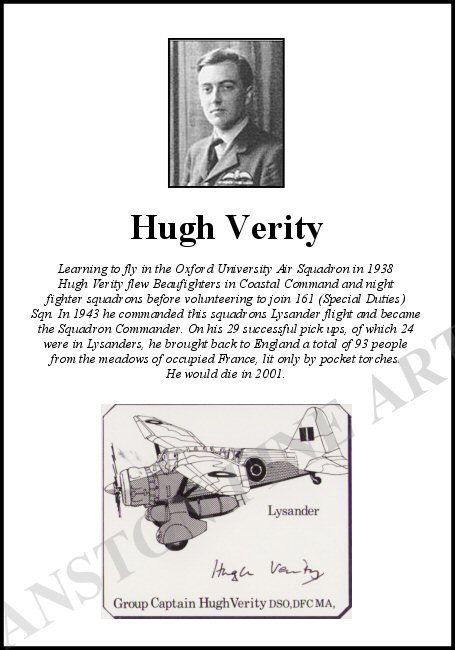
| Group Captain Hugh Verity DSO* DFC (deceased) Learning to fly in the Oxford University Air Squadron in 1938, Hugh Verity flew Beaufighters in Coastal Command and night fighter squadrons before volunteering to join 161 (Special Duties) Sqn. In 1943 he commanded this squadrons Lysander flight and became the Squadron Commander. On his 29 successful pick ups, of which 24 were in Lysanders, he brought back to England a total of 93 people from the meadows of occupied France, lit only by pocket torches. He died in 2001. |
Items Signed by Group Captain Hugh Verity DSO* DFC (deceased) |
  | Clipped Signature - Hugh Verity Price : £35.00 | Learning to fly in the Oxford University Air Squadron in 1938, Hugh Verity flew Beaufighters in Coastal Command and night fighter squadrons before volunteering to join 161 (Special Duties) Sqn. In 1943 he commanded this squadrons Lysander flight an...... | |
  | They Landed by Moonlight by Robert Taylor. Price : £210.00 | To fly a small aircraft at the dead of night, without radio communication or navigational assistance, deep into enemy-occupied territory, was an extremely perilous task. To then land on an unlit remote field, deliver secret agents, collect Resistanc...... | |
| | They Landed by Moonlight by Robert Taylor (AP) Price : £325.00 | To fly a small aircraft at the dead of night, without radio communication or navigational assistance, deep into enemy-occupied territory, was an extremely perilous task. To then land on an unlit remote field, deliver secret agents, collect Resistanc...... | |
| | They Landed by Moonlight by Robert Taylor (B) SOLD OUT | To fly a small aircraft at the dead of night, without radio communication or navigational assistance, deep into enemy-occupied territory, was an extremely perilous task. To then land on an unlit remote field, deliver secret agents, collect Resistanc...... | NOT AVAILABLE |
Packs with at least one item featuring the signature of Group Captain Hugh Verity DSO* DFC (deceased) |
 | Pack 516. Pack of two WW2 Lysander aircraft prints by Robert Taylor and Graeme Lothian. Pack Price : £280.00 Saving : £140 | Aviation Print Pack. ...... Titles in this pack : They Landed by Moonlight by Robert Taylor. Lysander Pick Up by Graeme Lothian (B) | |
 | Lysander Aircraft Art Prints by Robert Taylor and Steve Gibbs. Pack Price : £220.00 Saving : £90 | Aviation Print Pack. ...... Titles in this pack : Stealth 1944 by Steve Gibbs. They Landed by Moonlight by Robert Taylor. |
| Squadrons for : Group Captain Hugh Verity DSO* DFC (deceased) | ||
| A list of all squadrons known to have been served with by Group Captain Hugh Verity DSO* DFC (deceased). A profile page is available by clicking the squadron name. | ||
| Squadron | Info | |
Country : UK Founded : 1st June 1918 Fate : Disbanded 2nd June 1945 Liberate | No.161 Sqn RAF Full profile not yet available. | |
| Aircraft for : Group Captain Hugh Verity DSO* DFC (deceased) | |||
| A list of all aircraft associated with Group Captain Hugh Verity DSO* DFC (deceased). A profile page including a list of all art prints for the aircraft is available by clicking the aircraft name. | |||
| Squadron | Info | ||
Manufacturer : Westland Aircraft Production Began : 1938 Retired : 1946 Number Built : 1786 | Lysander The first Lysanders entered service in June 1938, equipping squadrons for army co-operation and were initially used for message-dropping and artillery spotting. When war broke out in Europe, the earlier Mk Is had been largely replaced by Mk IIs, the older machines heading for the Middle East. Some of these aircraft, now designated type L.1, operated with the Chindits of the British Indian Army in the Burma Campaign of the Second World War. Four regular squadrons equipped with Lysanders accompanied the British Expeditionary Force to France in October 1939, and were joined by a further squadron early in 1940. Following the German invasion of France and the low countries on 10 May 1940, the Lysanders were put into action as spotters and light bombers. In spite of occasional victories against German aircraft, they made very easy targets for the Luftwaffe even when escorted by Hurricanes. Withdrawn from France during the Dunkirk evacuation, they continued to fly supply-dropping missions to Allied forces from bases in England; on one mission to drop supplies to troops trapped at Calais, 14 of 16 Lysanders and Hawker Hectors that set out were lost. 118 Lysanders were lost in or over France and Belgium in May and June 1940, of a total of 175 deployed. With the fall of France, it was clear that the type was unsuitable for the coastal patrol and army co-operation role, being described by Air Marshal Arthur Barratt, commander-in-chief of the British Air Forces in France as "quite unsuited to the task; a faster, less vulnerable aircraft was required." Nevertheless, throughout the remainder of 1940, Lysanders flew dawn and dusk patrols off the coast and in the event of an invasion of Britain, they were tasked with attacking the landing beaches with light bombs and machine guns.[9] They were replaced in the home-based army co-operation role from 1941 by camera-equipped fighters such as the Curtiss Tomahawk and North American Mustang carrying out reconnaissance operations, while light aircraft such as the Taylorcraft Auster were used to direct artillery. Some UK-based Lysanders went to work operating air-sea rescue, dropping dinghies to downed RAF aircrew in the English Channel. Fourteen squadrons and flights were formed for this role in 1940 and 1941. In August 1941 a new squadron, No. 138 (Special Duties), was formed to undertake missions for the Special Operations Executive to maintain clandestine contact with the French Resistance. Among its aircraft were Lysander Mk IIIs, which flew over and landed in occupied France. While general supply drops could be left to the rest of No. 138's aircraft, the Lysander could insert and remove agents from the continent or retrieve Allied aircrew who had been shot down over occupied territory and had evaded capture. For this role the Mk IIIs were fitted with a fixed ladder over the port side to hasten access to the rear cockpit and a large drop tank under the belly. In order to slip in unobtrusively the Lysanders were painted matte black; operations almost always took place within a week of a full moon, as moonlight was essential for navigation. The aircraft undertook such duties until the liberation of France in 1944. The Lysanders flew from secret airfields at Newmarket and later Tempsford, but used regular RAF stations to fuel-up for the actual crossing, particularly RAF Tangmere. Flying without any navigation equipment other than a map and compass, Lysanders would land on short strips of land, such as fields, marked out by four or five torches. They were originally designed to carry one passenger in the rear cockpit, but for SOE use the rear cockpit was modified to carry two passengers in extreme discomfort in case of urgent necessity. The pilots of No. 138 and from early 1942, No. 161 Squadron transported 101 agents to and recovered 128 agents from Nazi-occupied Europe. The Germans knew little about the British aircraft and wished to study one. Soldiers captured an intact Lysander in March 1942 when its pilot was unable to destroy it after a crash, but a train hit the truck carrying the Lysander, destroying the cargo | ||
|
Contact Details |
Sign Up To Our Newsletter!
This website is owned by Cranston Fine Arts. Torwood House, Torwoodhill Road, Rhu, Helensburgh, Scotland, G848LE Contact: Tel: (+44) (0) 1436 820269. Email: cranstonorders -at- outlook.com
|
|


