|
|
|
|
|
|
|
|
|
| THIS ITEM IS INCLUDED IN OUR BUY ONE GET ONE HALF PRICE OFFER ! Choose any two prints in this special offer and the lower priced item is half price. (Any free bonus prints already supplied with an item are separate and will also be included !) Hundreds of items across our websites are included in this offer! |
| |||||||||||||||||||||||||||||
| |||||||||||||||||||||||||||||||||||||||||||
| Signatures on this item | |
| *The value given for each signature has been calculated by us based on the historical significance and rarity of the signature. Values of many pilot signatures have risen in recent years and will likely continue to rise as they become more and more rare. | |
| Name | Info |
 Miss Lettice Curtis *Signature Value : £20 | Joined the Air Transport Auxiliary (ATA) in July 1940 having been taken on to ferry Tiger Moths. Although we were later allowed to ferry other training types such as Oxfords and Masters, it was not until the autumn of 1941 that women were allowed to fly operational aircraft types. I flew my first Hurricane in August 1941 and my first Spitfire a couple of weeks later. After a brief course on a Blenheim I was cleared to fly without any further training, twin-engine bombers up to the Wellington. In November 1943 I was sent on a Halifax course, which due to unserviceability and bad weather closed, restarting in February 1943 at Pocklington where I was cleared for ferrying Halifaxes. After that without further training, I ferried Lancasters and over 100 Stirlings. In November 1945 I ferried 14 Liberators. |
 W/O J W Hill *Signature Value : £20 | Joined 196 Squadron on his 18th birthday, 25th November 1939, having cycled ten miles to the nearest recruiting office, hoping to enlist as an air gunner. However there were no vacancies and they eventually contacted him to suggest becoming a ground gunner. After square bashing on Blackpool promenade, he found himself guarding West Raynham aerodrome in Norfolk, where they were regularly strafed by German aeroplanes, flying extremely low. He then decided he would like to get his own back and volunteered for aircrew, this time as a pilot. After ACRC, Lords cricket ground, then ITW Scarborough, he found himself crossing the Atlantic in a convoy. There were numerous ships, containing budding aircrews, evacuated children and Italian prisoners of war. The fact that he had to sling his hammock at the very front of the ship, below the waterline, did nothing to boost his confidence, but they did have a number of destroyers for protection. Eventually, they docked at New York and then trans-shipped by rail to Moncton, New Brunswick, the holding terminal. His first experience of flying was at 32 EFTS Bowden, Alberta, where he flew Stearmans. He then moved on to Weyburn, Saskatchewan, where he obtained his wings, flying Harvards. Then it was back to England, this time travelling solo on a fast liner. He flew Tiger Moths at Banff, Scotland, then moved to twin-engine Oxfords, followed by Wellingtons. This was where he crewed up – he did one bombing raid on Wellingtons. Next he moved to 1665 Heavy Conversion Unit at Woolfox Lodge, flying Stirlings, then joined 196 Squadron on 5th November 1943. At the time of joining the Squadron, Stirlings were taken off bombing, and joined 38 group, assisting glider pilots with circuits and bumps, interspersed with operations to France, dropping supplies to the maquis. These trips were done at low level on moonlit nights, the theory being that they would be too low for both fighters and ground gunners to get at them. The biggest problem seemed to be avoiding high ground. On the night of 5th June, D-Day minus one, he dropped paratroopers near Caen, close to the now famous Pegasus Bridge. Then on D-Day itself, he towed a heavy Horsa glider to the Caen beachhead. During June he dropped more containers in the area. In September he made various trips to Arnhem. On one trip, due to fog over the North Sea, his glider became detached, finishing up in the sea. Luckily he later learnt the occupants were picked up by Air-Sea Rescue. These trips were done at a very low level, making them sitting ducks for the ground gunners. Aircraft losses were very severe: on one day, less than half the squadron got back to base, although some put down at other aerodromes. On one day, in addition to the gunners, there were German fighters overhead. He would have to take the decision to dive to the deck, lifting over the high-tension cables; the aeroplane escaped relatively lightly, with not much damage. He left the Squadron on completion of his tour in 38 group, on 6th June 1945. He then went back to 1665 HCU, this time as an instructor. Apart from a course on Oxfords at 7 FIS, he finished flying on 25th September 1945 and was demobbed on 27th March 1946, having completed a total of 1,021 hours flying. |
| The Aircraft : | |
| Name | Info |
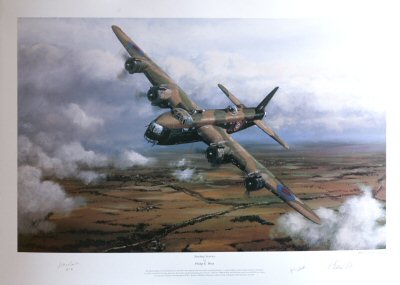
| Stirling | The Royal Air Force's first four engined monoplane Bomber, the Short Stirling first flew in May 1939 and entered front line service in August 1940 with no. 7 squadron. Due to its poor operational ceiling the aircraft sustained heavy losses and by mid 1942 the Stirling was beginning to be replaced by the Lancaster. Improved versions of the Short Stirling were built for Glider towing, paratroopers and heavy transport. also from 1943 many of the Stirling's were used for mine laying. A total of 2381 Stirling's were built for the Royal air Force and from this total 641 Stirling bombers were lost to enemy action. Crew 7 or 8: Speed: 260 mph (MK1) 275mph (MKIII) and 280mph (MKV)Service ceiling 17,000 feet Range: 2330 miles. (MK1) 2010 miles (MKIII) and 3,000 miles (MKV) Armament: two .303 Vickers machine guns. in nose turret, two .303 in browning machine guns in dorsal turret , Four .303 Browning machine guns in tail turret. Bomb Load 14,000 Lbs Engines: four 1150 Hp Bristol Hercules II (MK1) four 1650 hp Bristol Hercules XVI (MK111 and MKV) |
|
Contact Details |
Sign Up To Our Newsletter!
This website is owned by Cranston Fine Arts. Torwood House, Torwoodhill Road, Rhu, Helensburgh, Scotland, G848LE Contact: Tel: (+44) (0) 1436 820269. Email: cranstonorders -at- outlook.com
|
|


 Buy 1 Get 1 Half Price!