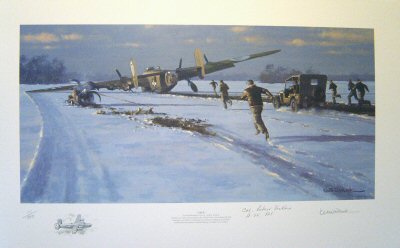
| Liberator | he initial production batch of B-24As was completed in 1941, with many being sold directly to the Royal Air Force. Sent to Britain, where the bomber was dubbed "Liberator," the RAF soon found that they were unsuitable for combat over Europe as they had insufficient defensive armament and lacked self-sealing fuel tanks. Due to the aircraft's heavy payload and long range, the British converted these aircraft for use in maritime patrols. Learning from these issues, Consolidated improved the design and the first major American production model was the B-24C which also included improved Pratt & Whitney engines.
In 1940, Consolidated again revised the aircraft and produced the B-24D. The first major variant of the Liberator, the B-24D quickly amassed orders for 2,738 aircraft. Overwhelming Consolidated's production capabilities, the aircraft was also built under license by North American, Douglas, and Ford. The latter built a massive plant at Willow Run, Michigan that, at its peak (August 1944), was producing fourteen aircraft per day. Revised and improved several times throughout World War II, the final variant, the B-24M, ended production on May 31, 1945.
he United States Army Air Forces (USAAF) took delivery of its first B-24As in mid-1941. Over the next three years, B-24 squadrons deployed to all theaters of the war: African, European, China-Burma-India, the Anti-submarine Campaign, the Southwest Pacific Theater and the Pacific Theater. In the Pacific, to simplify logistics and to take advantage of its longer range, the B-24 (and its twin, the U.S. Navy PB4Y) was the chosen standard heavy bomber. By mid-1943, the shorter-range B-17 was phased out. The Liberators which had served early in the war in the Pacific continued the efforts from the Philippines, Australia, Espiritu Santo,Guadalcanal, Hawaii, and Midway Island. The Liberator peak overseas deployment was 45.5 bomb groups in June 1944. Additionally, the Liberator equipped a number of independent squadrons in a variety of special combat roles. The cargo versions, C-87 and C-109 tanker, further increased its overseas presence, especially in Asia in support of the XX Bomber Command air offensive against Japan.
So vital was the need for long range operations, that at first USAAF used the type as transports. The sole B-24 in Hawaii was destroyed by the Japanese attack on Pearl Harbor on 7 December 1941. It had been sent to the Central Pacific for a very long range reconnaissance mission that was preempted by the Japanese attack.
The first USAAF Liberators to carry out combat missions were 12 repossessed LB-30s deployed to Java with the 11th Bombardment Squadron (7th Bombardment Group) that flew their first combat mission in mid-January. Two were shot up by Japanese fighters, but both managed to land safely. One was written off due to battle damage and the other crash-landed on a beach.
US-based B-24s entered combat service in 1942 when on 6 June, four B-24s from Hawaii staging through Midway Island attempted an attack on Wake Island, but were unable to find it. The B-24 came to dominate the heavy bombardment role in the Pacific because compared to the B-17, the B-24 was faster, had longer range, and could carry a ton more bombs.
In the European and North Africa Theatres On 12 June 1942, 13 B-24s of the Halverson Project (HALPRO) flying from Egypt attacked the Axis-controlled oil fields and refineries around Ploiești, Romania. Within weeks, the First Provisional Bombardment Group formed from the remnants of the Halverson and China detachments. This unit then was formalized as the 376th Bombardment Group, Heavy and along with the 98th BG formed the nucleus of the IX Bomber Command of the Ninth Air Force, operating from Africa until absorbed into the Twelfth Air Force briefly, and then the Fifteenth Air Force, operating from Italy. The Ninth Air Force moved to England in late 1943. This was a major component of the USSTAF and took a major role in strategic bombing. Fifteen of the 15th AF's 21 bombardment groups flew B-24s
1st August 1943 Operation Tidal Wave: A group of 177 American B-24 Liberator bombers, with 1,726 total crew, departed from Libya to make the first bombing of the oil refineries at Ploieşti, Romania, the major supplier of fuel to Germany. The mission temporarily halted oil production, but 532 airmen and 54 of the planes were lost. After a 40% loss of production, the refineries would be repaired more quickly than projected.[1] Germany's Radio Reconnaissance Service had intercepted and decrypted the Allied messages about the raid and the departure from Libya, and anti-aircraft defenses were in place despite the low-level approach of the bombers. |