|
|
|
|
|
|
|
|
|
| |||||||||||||||||||||||||||||
| Signatures on this item | |
| *The value given for each signature has been calculated by us based on the historical significance and rarity of the signature. Values of many pilot signatures have risen in recent years and will likely continue to rise as they become more and more rare. | |
| Name | Info |
  Air Commodore James Leathart (deceased) *Signature Value : £85 | After flight training, he joined No.54 Squadron flying Gauntlets. He became the commanding officer of No.54 Squadron as they re-equipped with Spitfire MkIs. In a remarkable event, he was awarded the DSO when he rescued the stranded CO of No.74 Sqn. Commandeering a Miles Master training aircraft, he flew to France escorted by other pilots from No.54 Sqn, and rescued the CO before returning across the Channel. It was for this action that he was awarded the DSO in June 1940. Died in 1998. |
  Air Vice Marshal Edward Crew CB DSO DFC (deceased) *Signature Value : £75 | Joining No 604 (County of Middlesex), an Auxiliary Air Force Squadron, in July 1940, Crew began to learn his trade as a night fighter pilot; among those with whom he flew at this time was John Cats' Eyes Cunningham, who himself became one of the most famous night fighter pilots of the war. It was a hard apprenticeship because Crew's Bristol Blenheim was equipped with early, and rudimentary, airborne radar, and much depended on the ability of his air gunner, Sgt Gus Guthrie, to adapt to his new calling as a radar operator. It was not until the following spring, when the squadron converted to two-engine Bristol Beaufighters, that the pair acquired a more suitable aircraft and sufficient expertise to dispatch five enemy bombers within a period of 10 weeks. This early run of success was speedily recognised with the award of the first of Crew's two DFCs. The citation stated: This officer is a pilot of outstanding ability who has shown tenacity of purpose to engage the enemy, which culminated in the destruction of two enemy aircraft in one night. Citations, by their very nature, are matter-of-fact, and do not capture the essence of their subjects. Others in the same squadron remembered Crew as a small, compact man who gave the impression of being larger than he was. He was seen as a patrician who hunted down his victims with a ferocity which was in marked contrast to his quietly spoken and always imperturbable manner. From the end of July 1941, Guthrie - Crew's eyes in combat - was posted away, and Crew was joined by Sgt Basil Duckett, with whom, in the spring of 1942, he achieved three further kills. Crew and Duckett made a brilliant team in which the radar operator's quiet persistence matched the pilot's natural hunting instincts. In early May 1942 Duckett enabled Crew to shoot down two Dornier 17 bombers on successive nights. Returning from the first of these encounters, over Portland in Dorset, Crew arrived back at base with the Dornier's trailing aerial wrapped around his Beaufighter's starboard propeller. Crew's second encounter developed into a long, drawn-out chase as he stalked the Dornier well out to sea off the Isle of Wight. As the enemy pilot twisted and turned to evade his pursuer, Crew refused to be shaken off, despite the fact that his guns were out of ammunition and Duckett was struggling to reload. Eventually, however, Crew's plane was able to deliver a burst which set the enemy bomber on fire and slowed it down as its gunner continued to return fire. At this point, the Beaufighter overshot the enemy aircraft, but Crew managed to keep it in view while Duckett again reloaded. Hunter and hunted continued to lose height until, at 2,000 ft, Crew saw the enemy crash into the sea, raising a plume of smoke and steam. Shortly afterwards Crew received a Bar to his DFC, the citation singling out his readiness to fly in all weather, his skill and ability in dealing with the enemy at night and his great example to the squadron. Edward Dixon Crew was born on December 24th 1917 at Higham Ferrers, Northamptonshire. He was brought up by his step-father, Sir Kenneth Murchison, a Tory MP, and educated at Felsted School and Downing College, Cambridge, where, in 1939, he joined the University Air Squadron. Following a sustained period of night operations with 604 Squadron, he was rested from October 1942 while commander of the Radio Development Flight; in March the following year he returned to operations in No 85, a Mosquito night fighter squadron. In June 1943 Wing Commander Crew received command of No 96 Squadron, leading its Mosquitoes against night raiders until the summer of 1944; this was when Hitler launched his so-called 'revenge weapons' against London and the South of England. Chasing pilotless V-1s - or 'chuff bombs', as Crew liked to call them - was by no means tame target practice. On June 25th he was on the tail of a V-1, travelling at high speed, when the force of the explosion as he shot it down split open his own aircraft's nose. Crew held the Mosquito steady long enough for his radar navigator, Warrant Officer W R Croysdill, to bail out over land. Then, as the Mosquito became uncontrollable, Crew himself jumped, landing safely near Worthing, in Sussex. Completing his Second World War operational career when 96 Squadron was disbanded in 1945, Crew was awarded the DSO. The citation emphasised his great skill in devising tactics to meet the menace of the flying bombs. That year he received a permanent commission and attended the RAF Staff College, before being posted in 1948 to command No 45 Beaufighter Squadron in the Far East. Operational once again, Crew led his squadron effectively against Communist insurgents aiming to destabilise Malaya. Harassing the jungle-based enemy in 100 night attacks, he consistently drove the terrorists into the hands of the security forces, for which he received a Bar to his DSO. The Air Ministry stated that Crew had displayed an almost uncanny knack in locating the target and attacking it on the first run in. From 1952 Crew served in Canada, where he commanded an operational training unit and introduced the Avro Canada CF100 all-weather fighter. After two years there he returned to command the all-weather development squadron at the Central Flying Establishment, with particular emphasis on trials of the Javelin. Later he commanded RAF Bruggen in Germany, before returning to the Far East in charge of the air task force in Borneo from 1965; his role here was dealing with the Indonesian Confrontation of the mid-1960s. Subsequently Crew commanded the Central Reconnaissance Establishment; he also served at the Ministry of Defence as Director of Operations (air defence and overseas), and was Deputy Air Controller of National Air Traffic Services. He retired as an air vice-marshal in 1973, when he joined the planning inspectorate of the Department of the Environment. Serving there until 1987, Crew was appointed CB in 1973 and elected a Fellow of the Royal Aeronautical Society in 1972. Air Vice Marshal Edward Crew CB DSO DFC died on the 18th August 2002 at the age of 84. |
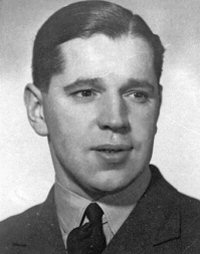 Group Captain Tom Gleave (deceased) *Signature Value : £40 | Gleave joined the RAF in 1930 after returning to Britain, qualifying as an exceptional pilot before serving with No. 1 Squadron and later as a flying instructor. At the outbreak of the Second World War he held staff appointments before taking command of No. 253 Squadron during the Battle of Britain. In August 1940 he was shot down and severely burned, undergoing extensive reconstructive surgery under Sir Archibald McIndoe at Queen Victoria Hospital, where he became a founding member and later Vice-President of the Guinea Pig Club. Returning to flying within a year, he commanded RAF Manston during the Channel Dash and the Dieppe operation, championing improvements that led to the construction of a long concrete runway to aid damaged returning aircraft. Promoted to Group Captain, Gleave played a pivotal role in Allied air planning, co-authoring the air strategy for Operation Overlord and later serving as Head of Air Plans at Supreme Headquarters Allied Expeditionary Force. His wartime service earned him numerous British and international honours, including the CBE, the French Légion d'Honneur and the US Bronze Star. After retiring from the RAF in 1953, he became an official historian with the Cabinet Office and remained a leading figure in the Guinea Pig Club and the Battle of Britain Fighter Association until his death in 1993. |
  Wing Commander Geoffrey Page DSO OBE DFC (deceased) *Signature Value : £85 | Geoffrey Page was born in Boxmoor on 16th May 1920. Geoffrey Page developed an early interest in aviation, which is not surprising as he had an uncle who flew during the Great War and another uncle was Sir Frederick Handley Page, the great aircraft manufacturer. Page went to Dean Close School in Cheltenham, Glouscestershire, and later went to the Imperial College to study engineering. It was at college he joined the University Air Squadron at Northolt. Two weeks after the outbreak of the Second World War, Geoffrey Page received his call-up papers and joined the RAF with the rank of Acting Pilot Officer and went to Cranwell for advanced training. In May 1940 after a short period of instructing, Page was posted to 66 Squadron, flying Supermarine Spitfires but was almost immediately re-assigned to 56 Squadron where he was to fly the Hawker Hurricane. Whilst as a pilot officer with 56 squadron he took part in the Battles of France and Britain, and had accounted for three kills by the time he was shot down on the 12th August 1940 during the Battle of Britain. Flying behind his commanding officer, who was attacking a large formation of Dornier Do17 bombers, his Hurricane was hit and caught fire. Burning high-octane fuel sprayed into the cockpit, covering Page, resulting in very bad burns to his face and hands. Page parachuted out and his Hurricane crashed into the sea. After being picked up from the sea he was taken to the burns unit at Queen Victoria Hospital in East Grinstead, where he was treated by Sir Archibald MacIndoe, a pioneering plastic surgeon. He spent the next two years in hospital undergoing numerous plastic surgery operations. Both of his hands were burnt down to the bone, and his head had swollen to three times its normal size. Page had also received gunshot wounds to his legs. Page became a founding member of the Guinea Pig Club, where Sir Archibald MacIndoe was elected life time president and Geoffrey Page was its first chairman. In late 1942 he re-joined operations again as a Flight Lieutenant. He joined No.132 Squadron as a supernumerary Flight Lieutenant, before volunteering for service in North Africa, but returned to the UK as the desert heat caused problems on his skin grafts. In July 1943 he won his first DFC. Later in the year he joined 122 Squadron as a Flight Commander, before re-joining No.132 Squadron in January 1944 as Commanding Officer. On 29th April 1944 Page led his squadron to strafe Deelen airfield in Holland, and attacked a Bf110 night fighter that was landing. Despite the odds, the Bf110 shot down two Spitfires, before Page forced the aircraft down and destroyed it. The pilot of the Bf110 was the famous Major Hans-Joachim Jabs, who survived. Page was later promoted Wing Leader of 125 wing, and after another DFC he won the DSO at the end of 1944. Page had achieved his goal of 15 victories (10 solo, 5 shared, and 3 damaged). After the war on a tour of the United States met his wife to be, the daughter of a British Hollywood actor. He left the R.A.F. in 1948 joining Vickers Armstrong. In retirement, Page remained the driving force of the Guinea Pig Club, and also founded the Battle of Britain Trust. This raised more than one million pounds, with which the Battle of Britain memorial was erected overlooking the Straits of Dover. In 1995 he was created an Officer of the Order of the British Empire. Sadly Alan Geoffrey Page DSO, OBE, DFC and Bar died 3rd August 2000. |
|
Contact Details |
Sign Up To Our Newsletter!
This website is owned by Cranston Fine Arts. Torwood House, Torwoodhill Road, Rhu, Helensburgh, Scotland, G848LE Contact: Tel: (+44) (0) 1436 820269. Email: cranstonorders -at- outlook.com
|
|


