Order Helpline (UK) : 01436 820269

You currently have no items in your basket


Buy with confidence and security!
Publishing historical art since 1985

Don't Miss Any Special Deals - Sign Up To Our Newsletter!
Aircraft
Search
Squadron
Search
Signature
Search
Artist
Search
SPECIAL
OFFERS

Product Search         
CLICK HERE FOR A FULL LIST OF ALL GERALD COULSON PRINTS BY TITLE
ALWAYS GREAT OFFERS :
20% FURTHER PRICE REDUCTIONS ON HUNDREDS OF LIMITED EDITION ART PRINTS
BUY ONE GET ONE HALF PRICE ON THOUSANDS OF PAINTINGS AND PRINTS
FOR MORE OFFERS SIGN UP TO OUR FREE NEWSLETTER

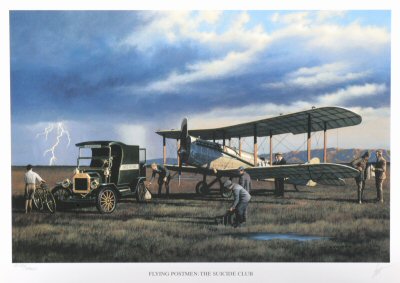
Flying Postmen by Stan Stokes. (B) - Gerald Coulson Prints

Flying Postmen by Stan Stokes. (B)


Please note that our logo is used on our website images only and does not appear on our products.


Flying Postmen by Stan Stokes. (B)

The inauguration of air mail service in the United States in 1918 would prove to be a very significant development in the evolution of the aviation industry. Spearheaded by Assistant Postmaster General Otto Praeger, Congress approved funding for a limited service between New York, Philadelphia, and Washington. The inaugural flights took place in May of 1918 utilizing US Army pilots and Curtiss JN-4H aircraft. Although initial public demand for air mail service was negligible, the Post Office demanded a damn-the-weather attitude from its pilots. This resulted in the Army withdrawing from this arrangement out of the fear of losing pilots and equipment. Not to be deterred, the Post Office ordered six new Standard bi-planes, and recruited its own pilots. Max Miller signed on as the Air Mail Services first civilian pilot, and flew his Standard from College Park Maryland on August 12, 1918, which was the first air mail flight utilizing civilian aircraft and pilots. The Standard which was designed as an Army trainer had developed a bad reputation for its Hall-Scott engine catching fire, and had been grounded by the Army. Re-fitted with the 150-HP Hispano Suiza engine, the Standard was faster than the Curtiss Jennies and had a much greater range. As the air mail service expanded westwards, the Allegheny Mountains presented a formidable obstacle for these fragile aircraft and their pilots, which had to navigate by following railroad tracks or other landmarks, often in terrible weather. Referred to as the Hell Stretch the mountains claimed many lives in what came to be termed the Suicide Club. E. Hamilton Lee was one of the early heroes of the Air Mail Service, pioneering routes between Chicago and Minneapolis and Chicago and St. Louis. Lee logged more than 4 million miles prior to his retirement in 1949. In the mid-1920s the Post Office had inaugurated night flying utilizing a unique series of beacons along its routes. The de Havilland D.H. 4 (depicted in Stan Stokes painting) became one of the mainstays of the Post Offices fleet, and constant modifications were made to these aircraft including experiments with air-to-ground radios, and ingenious navigational aids and flight instruments. In the 1920s the Post Office opened up many of its routes to private carriers, which assisted many early commercial airlines in getting started in business. In the late 1920s many new aircraft debuted as mail carriers including the Stearman C-3MB, the Pitcairn PA-5, and the Boeing 40B. The Northrup Alpha, a unique all-metal, cantilever-wing design was used to pioneer coast-to-coast routes in the early 1930s. One lasting byproduct of this era are the numerous air-mail stamps and first day covers which flew the world, and are now prized by both aviation buffs and stamp collectors alike.
Item Code : STK0172BFlying Postmen by Stan Stokes. (B) - This Edition
TYPEEDITION DETAILSSIZESIGNATURESOFFERSYOUR PRICEPURCHASING
PRINT Limited edition of 100 giclee art prints.

Just two of this print edition now available.
Size 21 inches x 14 inches (53cm x 36cm)Artist : Stan Stokes£145.00

Quantity:
All prices on our website are displayed in British Pounds Sterling


Other editions of this item : Flying Postmen by Stan Stokes.STK0172
TYPEEDITION DETAILSSIZESIGNATURESOFFERSYOUR PRICEPURCHASING
PRINT Signed limited edition of 4750 prints.

Supplied with signed and numbered certificate of authenticity.
Print size 16 inches x 11.5 inches (41cm x 30cm) Artist : Stan Stokes£15 Off!Add any two items on this offer to your basket, and the lower priced item will be half price in the checkout!Now : £35.00VIEW EDITION...
General descriptions of types of editions :

Extra Details : Flying Postmen by Stan Stokes. (B)
About all editions :


A photo of an edition of the print.

The Aircraft :
NameInfo
DH4The DH.4 entered service with the RFC in January 1917, first being used by No. 55 Squadron. More squadrons were equipped with the type to increase the bombing capacity of the RFC, with two squadrons re-equipping in May, and a total of six squadrons by the end of the year. As well as the RFC, the RNAS also used the DH.4, both over France and over Italy and the Aegean front. The DH.4 was also used for coastal patrols by the RNAS. One, crewed by the pilot Major Egbert Cadbury and Captain Robert Leckie (later Air Vice-Marshal) as gunner, shot down Zeppelin L70 on 5 August 1918. Four RNAS DH.4s were credited with sinking the German U-boat UB 12 on 19 August 1918. The DH.4 proved a huge success and was often considered the best single-engined bomber of World War I. Even when fully loaded with bombs, with its reliability and impressive performance, the type proved highly popular with its crews. The Airco DH.4 was easy to fly, and especially when fitted with the Rolls-Royce Eagle engine, its speed and altitude performance gave it a good deal of invulnerability to German fighter interception, so that the DH.4 often did not require a fighter escort on missions, a concept furthered by de Havilland in the later Mosquito in World War II. A drawback of the design was the distance between pilot and observer, as they were separated by the large main fuel tank. This made communication between the crew members difficult, especially in combat with enemy fighters. There was also some controversy (especially in American service) that this placement of the fuel tank was inherently unsafe. In fact, most contemporary aircraft were prone to catching fire in the air. The fire hazard was reduced, however, when the pressurised fuel system was replaced by one using wind-driven fuel pumps late in 1917,[11] although this was not initially adopted by American-built aircraft.[14] The otherwise inferior DH.9 brought the pilot and observer closer together by placing the fuel tank in the usual place, between the pilot and the engine. Despite its success, numbers in service with the RFC actually started to decline from spring 1918, mainly due to a shortage of engines, and production switched to the DH.9, which turned out to be disappointing, being inferior to the DH.4 in most respects. It was left to the further developed DH.9A, with the American Liberty engine, to satisfactorily replace the DH.4. When the Independent Air Force was set up in June 1918 to carry out strategic bombing of targets in Germany, the DH.4s of 55 Squadron formed part of it, being used for daylight attacks. 55 Squadron developed tactics of flying in wedge formations, bombing on the leader's command and with the massed defensive fire of the formation deterring attacks by enemy fighters.[15] Despite heavy losses, 55 Squadron continued in operation, the only one of the day bombing squadrons in the Independent Force which did not have to temporarily stand down owing to aircrew losses. After the Armistice, the RAF formed No. 2 Communication Squadron, equipped with DH.4s to carry important passengers to and from the Paris Peace Conference. Several of the DH.4s used for this purpose were modified with an enclosed cabin for two passengers at the request of Andrew Bonar Law. These aircraft were designated DH.4A, with at least seven being converted for the RAF, and a further nine for civil use

Contact Details
Shipping Info
Terms and Conditions
Cookie Policy
Privacy Policy

Sign Up To Our Newsletter!

Stay up to date with all our latest offers, deals and events as well as new releases and exclusive subscriber content!

This website is owned by Cranston Fine Arts.  Torwood House, Torwoodhill Road, Rhu, Helensburgh, Scotland, G848LE

Contact: Tel: (+44) (0) 1436 820269.  Email: cranstonorders -at- outlook.com

Return to Home Page