Please note that our logo is used on our website images only and does not appear on our products.

|
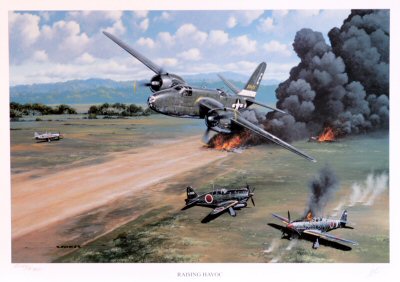
Raising Havoc by Stan Stokes.
In 1936, under the supervision of Jack Northrop and Ed Heinemann, Douglas Aircraft began work on a new twin-engine light attack/observation aircraft designated the Model 7A. Powered by two R985 Wasp radials mounted in wing nacelles, the A-20 also utilized a tricycle landing gear configuration. The aircrafts fuselage was quite narrow and there was room for only 1 pilot and 1 crewmember. As the project proceeded it became clear that the 7A was not going to meet the Armys objectives. In early 1938, Northrop left Douglas to form his own company, and Heinemann began work on upgrading their design. One interesting feature was the use of interchangeable nose sections. A clear nose could be fitted with a bombardiers compartment, or alternatively a solid nose section could be fitted with an impressive total of 8 machine guns. More powerful Pratt and Whitney radials were incorporated into the design. Now designated the DB-7 by Douglas, a prototype aircraft was completed by October 1938. The new aircraft proved very fast, highly maneuverable, and capable of carrying a 2000 pound bomb load. While impressed with the aircrafts specs, the Army placed no immediate orders. The French, however, were impressed with this aircraft, and anxious to match the build-up of the Luftwaffe, they ordered more than 270 aircraft. The Havoc first saw combat in 1939 flying with the French Air Forces during the Battle of France. The French had received about 64 aircraft, and following the fall of France a decision was made to divert the balance of the French order to the RAF. By mid-1939 the Army placed an initial order for 63 A-20s. The A-20B variant was built in significant numbers with most being sent to Russia. (Almost 50% of the A-20s produced during the War were sent to Russia where they were utilized in many combat roles, including torpedo bombing.) The most significant variant was the G model with nearly 3000 produced. The G variant was produced with a solid nose section with lots of firepower. Many of the G models were fitted with an electrically driven Martin gun turret. More fuel tank capacity was added and with twin 1600-HP radials the A-20Gs were capable of a range in excess of 1000 miles, and could attain top speeds in excess of 340-MPH. The maximum bomb load was increased to 4000 pounds. The A-20 was the ideal low-level attack bomber. With its high speed, excellent maneuverability, and heavy firepower, Havocs were well suited for pinpoint bombing attacks on airfields, ammo dumps, etc. With their incredible forward firing power a flight of A-20s could easily overwhelm shipboard anti-aircraft guns. A-20s saw a lot of service in the Pacific. The Allied campaign of slowly retaking key islands was aided by the capabilities of the Havoc. Attacks on Japanese airfields with the A-20 were made with disastrous consequences to the Japanese, and there are several instances where flights of A-20s virtually wiped out Japanese ship convoys. Some A-20s were modified into night fighters (designated P-70) prior to the use of P-61 Black Widows. In Stan Stokes painting an A-20 in service with the 386th Bomb Squadron of the 312th Bomb Group rips up a Japanese airfield in Dutch New Guinea. |


 Buy 1 Get 1 Half Price!