|
|
|
|
|
|
|
|
|
| |||||||||||||||||||||||||||||
| ||||||||||||||||||||||||||||||||||||||||||||||
| Signatures on this item | |
| *The value given for each signature has been calculated by us based on the historical significance and rarity of the signature. Values of many pilot signatures have risen in recent years and will likely continue to rise as they become more and more rare. | |
| Name | Info |
  USAF Gen John T Chain Jr (deceased) *Signature Value : £45 | Gen. Chain served for nearly five years as the next-to-last Commanding Officer of the Strategic Air Command. Gen. Chain is a command pilot with 5,000 flying hours, including 400 combat hours. He has flown more than forty-five different military aircraft. He is also a master parachutist with sixty-six jumps to his credit. The General was born December 11, 1934 in Wilmington, Delaware. He attended the Fork Union Military Academy and earned a bachelor of arts degree in history in 1956. He was commissioned as a second lieutenant through the Air Force Reserve Officer Training Corps program, and earned his pilots wings in 1957. General Chain flew F-100s with the 50th Tactical Fighter Wing at Toule-Rosieres Air Base in France, and with the 417th Tactical Fighter Squadron at Ramstein Air Base in Germany. He later served as flight examiner with the 524th Tactical Fighter Squadron at Cannon Air Base in New Mexico. In June of 1964 he was assigned to Ft. Campbell, Kentucky where he served as a forward air controller with the 101st Airborne Division. At Ft. Campbell, the General became a master parachutist and flew 0-1s and F84s. In 1966, he flew combat missions out of Tan Son Nhut in Vietnam as an adviser, prior to being assigned to Washington where he served as an exchange officer with the Dept. of State. In 1971 he graduated from the National War College and concurrently earned a masters degree in international affairs from George Washington University. General Chain returned to combat flying in 1972 when he flew F-4s out of Thailand. He was appointed Deputy Commander of the 35th Tactical Fighter Wing in California upon his return. Later he was transferred to Langley Air Base in Virginia, with the F-15 equipped 1st Tactical Fighter Wing. He served in various capacities and eventually assumed command of the Wing. In 1978 he was promoted to Brigadier General and was the military assistant to the Secretary of the Air Force. General Chain's numerous awards and decorations include the Distinguished Service Medal with oak leaf cluster, the Legion of Merit, the Distinguished Flying Cross with oak leaf clusters, the Bronze Star Medal, the Meritorious Service Medal with two oak leaf clusters, the Air Medal with ten oak leaf clusters, Air Force Commendation Medal, the Air Force Outstanding Unit Award with oak leaf cluster, the Air Force Organizational Excellence Award, the Combat Readiness Medal, the National Defense Service Medal, the Vietnam Service Medal with four stars, the Air Force Longevity Service Award Ribbon with six oak leaf clusters, the Republic Vietnam Distinguished Medal, just to name a few. Sadly John would pass away on July 7th 2021. |
| The Aircraft : | |
| Name | Info |
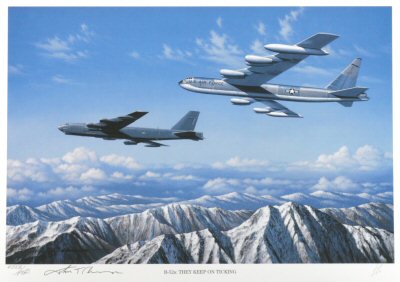
| Stratofortress | The Boeing B-52 Stratofortress has played a major role in Americas defense for nearly forty years. In his dramatic painting appropriately entitled B-52s: They Keep On Ticking, aviation artist Stan Stokes depicts an early big-tailed B-52B and a more contemporary B-52G which saw service during Operation Desert Storm. The origins of the development of the B-52 begins way back in the early 1940s. All major aircraft companies were interested in developing the first truly intercontinental bomber. Shortly after WW II the Convair XB-36 and the Northrop XB-35 were developed, and both had intercontinental range. However, neither of these aircraft were capable of penetrating deep into Soviet airspace, and defense planners in the early 1950s presumed that the Soviets would be our prime adversaries for years to come. In 1946 the Air Force issued a requirement for its next generation of strategic bombers. Required was a range of at least 5,000 miles with a minimum 10,000 pound bomb load, a top speed in excess of 450 MPH and an operational ceiling of at least 40,000 feet. Boeing entered this competition with the XB-52 which incorporated six turboprop engines. Part way into prototype development, Boeings designers decided to scrap this design in favor of a swept wing jet powered aircraft. The first XB-52 was rolled out in November of 1951. One major change in the prototype was a complete redesign of the forward fuselage to allow the pilots to sit side-by-side. The B-52B was the first true production model of the Stratofortress. It became operational in 1955 with the Strategic Air Command. On January 16, 1957 SAC demonstrated the amazing capabilities of the B-52 with a non-stop around the world flight covering over 24,000 miles in 45 hours and 19 minutes. The B-52B was phased out in the mid 1960s. The B-52C was the first of these aircraft to be painted gloss white on its entire underside to reflect the heat from nuclear blasts. The C remained in service until 1971. The B-52D saw significant service in Vietnam. Many of these models were modified to carry up to as many as 108 conventional bombs. During a major offensive strike at Hanoi in December 1972 a total of 729 B-52 sorties were flown. Only 15 aircraft were lost, despite the fact that Hanoi was heavily protected with SAMs and anti-aircraft batteries. The B-52G was the first of the short tail models. The manned rear gun turret was removed on these models, and the fuel capacity was significantly increased. The G model was the first of the B-52s to carry cruise missiles, a development which significantly lengthened the useful service life of this aircraft. The B-52G is, like its predecessors, a very large aircraft with a wingspan in excess of 185 feet, and a maximum take off weight of 488,000 pounds. With a range in excess of 7,000 miles and a maximum speed of 634 MPH, the Gs were successfully utilized in the Gulf War, and no doubt will continue to see service for many more years into the future. The B-52 is clearly one of the most unique of all post-WW II military aircraft, and it is interesting to note that it is one of only a very few aircraft designs which is older than most of the pilots who fly it. |
|
Contact Details |
Sign Up To Our Newsletter!
This website is owned by Cranston Fine Arts. Torwood House, Torwoodhill Road, Rhu, Helensburgh, Scotland, G848LE Contact: Tel: (+44) (0) 1436 820269. Email: cranstonorders -at- outlook.com
|
|