|
|
|
|
|
|
|
|
|
| Ivan Berryman |
|
Over the last 30 years, Ivan Berryman has become a leading aviation, motor racing and naval artist. In this time, the subjects of his paintings have been wide and varied as he has deliberately strived to include some of the lesser know aircraft, ships and events in his portfolio, which includes aircraft like the Defiant, TSR2, Beaufort, ships including MTBs and corvettes, and around 100 different aircraft of the first world war. In addition to this he has taken new approaches to the classic subjects of his field, including the Dambuster Lancasters, Battle of Britain Spitfires, Bf109s and Hurricanes, HMS Hood, Bismarck and the best known naval ships, as well as some iconic sporting moments. In his own words : Art and aviation have been like a brother and sister to me. We have grown up together, learned together and made our adult lives together. But you do not have to have an appreciation of aircraft to admire the graceful lines of a Spitfire or the functional simplicity of a Focke-Wulf 190. They are themselves a work of art and they cry out to be painted - not as machines of war and destruction, but as objects of beauty, born of necessity and function, yet given a life and iconic classicism beyond their original calling. My interest and love of art and aircraft was gifted to me by my father, a designer and aeronautical engineer of considerable repute. Denis Berryman C.Eng. FRAeS. He gave me his eyes, his passion, his dedication and his unwavering professionalism. I owe him everything. And I miss him terribly. A love of art and of beautiful and interesting things takes you on a journey. You discover new interests, new fascinations, and you want to paint them. You want to paint them in their environment, in their element. Whether it is an aeroplane, a warship, a racing car or a beautiful woman, their gift to an artist is the same: Their lines, their texture and the way that light and shadows give them form. These are the food and oxygen of an artist. Not the paint and the canvas. These are mere tools. The secret is in the passion and the perception... |
| Navigation | |
| Page 6 of 34 | Previous .. Page 6 .. Next |
|
|
|
|
|
|
|
|
|
|
|
|
|
|
|
|
|
|
|
|
|
| Navigation | |
| Page 6 of 34 | Previous .. Page 6 .. Next |
| Text for the above items : |
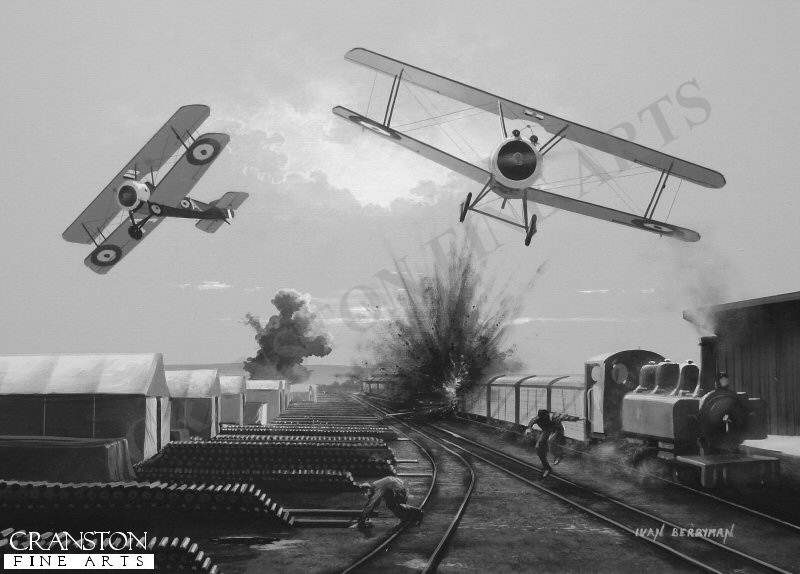
Mayhem at Vieille Chapel by Ivan Berryman. (PC) No text for this item |
Nerves of Steel by Ivan Berryman. Just moments from her devastating opening broadside, HMS Victory prepares to pass the stern of the French flagship, Bucentaure, to break through the line of the combined French and Spanish fleets as the Battle of Trafalgar begins on 21st October 1805. Victorys guns had remained silent until this moment, Lord Nelsons flagship having already suffered severe damage during the approach, but now the gun crews awaited the moment when her double-shotted cannon, her mighty 68-pounder carronade and a shower of musket balls would smash through the French vessel, rendering it at once a useless hulk. |
Attack on the Scharnhorst by Ivan Berryman. Swordfish of 825 Sqn led by Lt-Cdr Esmonde begin their heroic attack on the battlescruisers Scharnhorst and Gneisenau and the heavy cruiser Prinz Eugen as they make their way up the English Channel from Brest during Operation Cerberus on 12th February 1942. Although all the aircraft were lost and no significant damage was done to the German fleet, all the pilots were decorated for their bravery and Lt-Cdr Esmonde received the first Fleet Air Arm VC to be awarded, albeit posthumously. The painting depicts the first wave of Swordfish attacking the Scharnhorst with Gneisenau taking avoiding action in the distance. A German torpedo boat has turned to confront the attacking aircraft. |
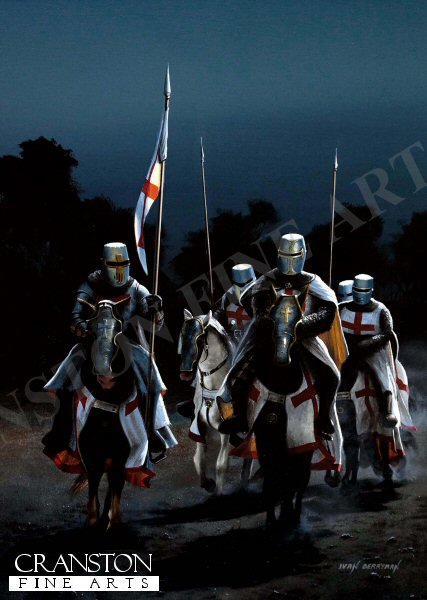
God's Work by Ivan Berryman. A key stratagem of the Knights Templar was the Squadron Charge in which a group of knights and their armoured warhorses would charge towards enemy lines at full speed. This displayed their ferocity and sheer determination and would often break a hole in enemy lines, allowing the tides of battle to change in favour of the Knights Templar forces. |
Friday the 13th by Ivan Berryman. Sadly, but two examples of the Handly Page Halifax exist today - the unrestored W1048 at the RAF Museum at Hendon, and the Yorkshire Air Museums pristine LV907 Friday the 13th, a rebuild from the remains of HR792. In this portrait of one of Bomber Command's oft-forgotten workhorses, the original Friday the 13th is set against a stunning evening cloudscape. |
Kleiner Freund - Zeppelin Staaken R.VI by Ivan Berryman. With a wingspan of 42.2 metres, the mighty Zeppelin Staaken series of bombers were truly awesome, living up to their name Riesenflugzeug - Giant Aircraft. Unusually for this period, the crew compartment of the R VI was fully enclosed and the bomb load was carried internally. The four engines were mounted in tandem pairs, two pushing and two pulling, which eliminated the need for complex gearing, and the flight engineers sat in cockpits in the engine nacelles. This example is shown limping home, its rear port engine stopped and smoking, escorted by its Little Friend, an Albatros D.V. The painting shows the Staaken bomber is quite badly shot up. There are bullet holes all over the port wings, tailplane and rudder, as well as the engine trailing smoke from a small oil fire in the nacelle, which the engineer is keeping an eye on. |
Tribute to P/O Derek Tapson by Ivan Berryman. On a low-level mission over the Rhine on 10th February 1945, P/O Derek Tapson's Hawker Typhoon, PD447 (OV-F) was struck in the engine by a nearby flak burst. In attempting to bail out, Tapson hit his head on the windscreen surround and lost conciousness, recovering just in time to pull the ripcord on his parachute and land safely among the German AA battery that had shot him down. |
Into the Schwarm by Ivan Berryman. The lone Spitfire of Maurice Peter Brown of No.41 Sqn, single-handedly attacks a group of eight Me109s on 25th October 1940. |
Dambusters over the Mohne by Ivan Berryman. Tracer fire streaks past two Dambuster Lancasters of No.617 Sqn as the decisive Barnes-Wallace bouncing bomb skips towards the dam in the moonlit background. Fire from the already burning buildings lights up the front face of the dam and reflects off the aircraft as they throttle up to make good their escape. |
HMS Onslaught by Ivan Berryman. With her pennant number GO4 painted out to accommodate a western approaches camouflage the destroyer HMS Onslaught punches her way through a heavy swell during escort duties in the north Atlantic |
HMS Lion at the Battle of Jutland by Ivan Berryman. HMS Lion with her sister ship HMS Princess Royal are shown firing on the German High Seas Fleet which can be seen in the distance during the Battle of Jutland. |
Close Combat by Ivan Berryman. Whilst flying with A Flight of 85 Squadron on 30th July 1940, Geoffrey Allard encountered a pair of Messerschmitt Bf.110s about 40 miles from the coast, apparently patrolling near a convoy. After Squadron Leader Townsend, flying Red 1, had made two unsuccessful attacks, Allard closed to 150 yards and began to fire continuously, eventually closing to just 25 yards, whereupon the starboard engine of the Bf.110 began to disintegrate. This was just one of eight victories that Allard claimed during the Battle of Britain to add to a previous eight that he had scored flying Hurricanes during the Battle of France. |
Captain Andrew Beauchamp-Proctor by Ivan Berryman. Standing just five feet two inches tall, Andrew Beauchamp-Proctor had to have his SE5a specially modified to accommodate his small stature, but the diminutive South African was a giant in the air, claiming a total of 54 victories before the end of the war, many of them observation balloons which made him one of the top balloon-busting aces of the RFC. But many aircraft fell to his guns, too, as here when on 21st August 1918 he claimed an Albatros C-Type as victory number 34 whilst flying D6856 of 84 Squadron. |
Typhoon! by Ivan Berryman. So often overshadowed by its own achievements as a ground attack aircraft, Hawkers mighty Typhoon also proved itself a formidable adversary in air to air combat as demonstrated by the successes of F/Lt (later Wing Commander) J R Baldwin who claimed no fewer than three Bf.109G4s in the skies above Kent on 20th January 1943 in a single sortie. Baldwin finished the war as the highest-scoring Typhoon pilot of all with 15 confirmed victories, one shared, one probable and four damaged. He was tragically lost over Korea in 1952 whilst on an exchange posting with the USAF, but is depicted here at the peak of his powers, flying Typhoon 1B DN360 (PR-A) of 609 Sqn. |
Nigel Mansell, McLaren MP4/10/B by Ivan Berryman. No text for this item |
HMS Poseidon by Ivan Berryman. Launched in Barrow in Furness on 22nd August 1929, the Parthian Class submarine HMS Poseidon (P99) was destined to meet a tragic fate on 9th June 1931 when she was inexplicably involved in a collision with a Chinese freighter in the Bohai Sea during exercises in clear visibility. 31 of her crew managed to get into the water before the submarine sank, whilst a further eight escaped from the submerged vessel. Two of these didn't make it to the surface and one died later in hospital, making a tragic total of 21 deaths in this extraordinary tragedy. HMS Poseidon is depicted here in happier times, moving off from her depot ship as the night sky closes in. |
The Drive to Juno by Ivan Berryman. On 6th June 1944, D-Day, the Canadian steamship HMCS Prince David (F89), seen here in the background, released her compliment of landing craft embarking elements of Le Regiment de la Chaudiere, plus some Royal Marines, bound for Mike and Nan beaches. Their mission was to clear mines and provide cover for the assault craft that were to follow. By the close of the day, all of her landing craft had been lost to enemy action except one that was accidentally forced onto a semi-submerged obstacle by a friendly tank carrier. |
Tirpitz in Kaafjord by Ivan Berryman. The mighty Tirpitz demonstrates the effectiveness of her splinter camouflage, surrounded by her net defences at Kaafjord in the Winter of 1943-44. |
The Pursuit of the Graf Spee by Ivan Berryman. No text for this item |
Major Edward Mannock by Ivan Berryman. Despite having sight in just one eye, Major Edward Mick Mannock was to become one of the most decorated and celebrated aces of World War 1, bringing down an official 61 enemy aircraft in just eighteen months before himself being brought down in flames by enemy ground fire. He was reluctant to add shared kills to his tally, so his actual total of victories is recorded at 73. His decorations include the VC, DSO and 2 Bars, MC and Bar and he is depicted here diving on enemy aircraft in SE5a D278 of 74 Sqn in April, 1918. |
An Early Bath by Ivan Berryman. In the early evening of the 18th of July 1941, following coastguard reports of an enemy aircraft in their vicinity, two Hurricanes of 87 Sqn on detachment at the Airfield at St Mary's, Scilly Isles were scrambled to an area some 30 miles south west of the Scilly Isles where they intercepted a lone Heinkel He111. Alex Thom was the first to attack, his windscreen being sprayed with oil as his rounds tore into the Heinkel's starboard engine. Breaking away, his wingman F/O Roscoe now took over the chase, but the German bomber was already mortally wounded and was observed to alight onto the sea where upon the crew immediately took to their life raft as the Heinkel began to sink beneath the waves just minutes later, Thom circled overhead until he saw the motor launch arrive to pick up the German aircrew before returning back to St Mary's. |
|
Contact Details |
Sign Up To Our Newsletter!
This website is owned by Cranston Fine Arts. Torwood House, Torwoodhill Road, Rhu, Helensburgh, Scotland, G848LE Contact: Tel: (+44) (0) 1436 820269. Email: cranstonorders -at- outlook.com
|
|