|
|
|
|
|
|
|
|
|
| Ivan Berryman |
|
Over the last 30 years, Ivan Berryman has become a leading aviation, motor racing and naval artist. In this time, the subjects of his paintings have been wide and varied as he has deliberately strived to include some of the lesser know aircraft, ships and events in his portfolio, which includes aircraft like the Defiant, TSR2, Beaufort, ships including MTBs and corvettes, and around 100 different aircraft of the first world war. In addition to this he has taken new approaches to the classic subjects of his field, including the Dambuster Lancasters, Battle of Britain Spitfires, Bf109s and Hurricanes, HMS Hood, Bismarck and the best known naval ships, as well as some iconic sporting moments. In his own words : Art and aviation have been like a brother and sister to me. We have grown up together, learned together and made our adult lives together. But you do not have to have an appreciation of aircraft to admire the graceful lines of a Spitfire or the functional simplicity of a Focke-Wulf 190. They are themselves a work of art and they cry out to be painted - not as machines of war and destruction, but as objects of beauty, born of necessity and function, yet given a life and iconic classicism beyond their original calling. My interest and love of art and aircraft was gifted to me by my father, a designer and aeronautical engineer of considerable repute. Denis Berryman C.Eng. FRAeS. He gave me his eyes, his passion, his dedication and his unwavering professionalism. I owe him everything. And I miss him terribly. A love of art and of beautiful and interesting things takes you on a journey. You discover new interests, new fascinations, and you want to paint them. You want to paint them in their environment, in their element. Whether it is an aeroplane, a warship, a racing car or a beautiful woman, their gift to an artist is the same: Their lines, their texture and the way that light and shadows give them form. These are the food and oxygen of an artist. Not the paint and the canvas. These are mere tools. The secret is in the passion and the perception... |
| Navigation | |
| Page 5 of 34 | Previous .. Page 5 .. Next |
|
|
|
|
|
|
|
|
|
|
|
|
|
|
|
|
|
|
|
|
|
| Navigation | |
| Page 5 of 34 | Previous .. Page 5 .. Next |
| Text for the above items : |
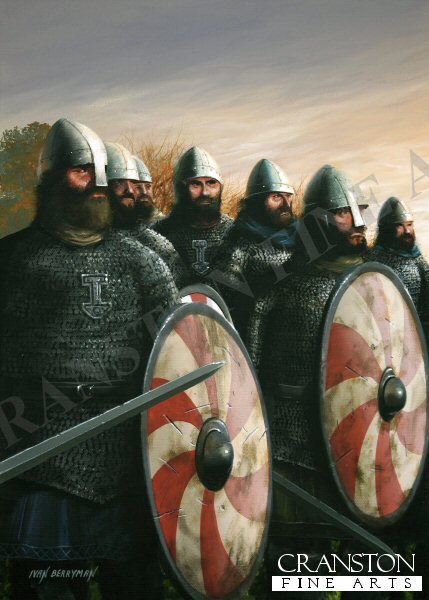
The 14th Dawn by Ivan Berryman. Depicted here at dawn of the battle of Hastings on the 14th of October 1066, the core of King Harold Godwinson's army was made up of housecarls, full-time professional soldiers. Their armour consisted of a conical helmet, a mail hauberk, and a shield. |
Deutschland Passing Through the Kiel Canal by Ivan Berryman. No text for this item |
Focke-Wulf Fw190A-5/U8 by Ivan Berryman. Focke-Wulf FW.190A-5/U8 of 1 Gruppe, Schnellkampfgeschwader 10 in 1943. All national markings were painted out, except for the call sign C on the fuselage and repeated, crudely sprayed, on the engine cowling. |
Flight Lieutenant Rutland and Assistant Paymaster Trewin Locate the German Fleet at Jutland, 31st May, 1916 by Ivan Berryman. Having spotted smoke on the horizon, Vice-Admiral Sir David Beatty ordered that a floatplane be immediately launched from HMS Engadine to investigate. Without delay, Short 184 (serial No 8359) was airborne, but had to maintain a modest altitude due to the low cloud base. Flight Lieutenant Frederick Rutland (who would forevermore be known as Rutland of Jutland) and his observer G.S. Trewin, quickly spotted the German fleet, but found their radio transmissions to be jammed and, upon encountering engine problems, were forced to return to their tender where they were able to file their report. Sadly, an increasing swell made a further flight impossible and their report failed to be relayed to the British Fleet who continued their engagement with the Germans without the benefit of aerial reconnaissance. |
Anton Hafner by Ivan Berryman. The top scoring ace of JG.51, Anton Hafner is credited with 204 confirmed victories. A prolific scorer, on 8th August 1944, he shot down no fewer than seven Russian Sturmoviks and, by October of that year, his overall tally had exceeded 200. He died in combat with a Yak 7, his 204th victim, when his aircraft hit a tree. He is shown here in Messerschmitt Bf.109G-6 442013 Black 1. |
RMS Titanic. Ship of Dreams by Ivan Berryman. The elegant but ill-fated jewel in the White Star crown Titanic was a technical marvel of engineering in its day. At 882 ft long, her perfect proportions and magnificent profile were the envy of other shipping companies. Her tragic loss on her maiden voyage was a crushing blow to the White Star Line that left the whole world in shock. |
HMS Colossus by Ivan Berryman Together with her sister ship, Hercules, HMS Colossus acquitted herself well at the Battle of Jutland where she fired 93 12in rounds, but received only two hits from enemy fire which caused minor damage and left nine crew injured. She was sold for scrap in 1928. |
Outnumbered by Ivan Berryman. On 1st February 1918, the great Austro-Hungarian ace Godwin von Brumowski found himself abandoned by his wingmen and left to fight off eight Sopwith Camels of 45 Sqn RFC single handed. On this occasion, it was he that came off the worst, managing to nurse his badly damaged Albatros D.III (Oef) 153.45 back to base, the aircraft becoming engulfed in flames at some point, probably due to a hit in the fuel tank. The fuselage of his machine was riddled with 26 bullet holes and the fabric of the wings was punctured and shredded, but he continued the fight until his guns jammed and he was forced to break away. Undaunted, the Ace was back in the air the next day, only to have these dreadful events repeat themselves just three days later, Brumowski again nursing his shattered aircraft home. |
Schumacher at Spa by Ivan Berryman. Michael Schumacher hurtles round the famous Eau Rouge corner at the Spa-Francorchamps circuit at the Belgian Grand Prix. Schumacher won this event in his Ferrari in 1996, 1997, 2001 and 2002, completing a total of 6 wins at one of the legendary Formula One circuits. |
HMS Tiger - Battle Survivor by Ivan Berryman (PC) During the First World War, HMS Tiger was fortunate to survive both the Battle of Dogger Bank and the Battle of Jutland, having been hit multiple times in both engagements. At Jutland, HMS Queen Mary exploded and sank just a few hundred yards ahead of HMS Tiger, the latter taking evasive action to dodge the wreckage and resulting smoke cloud. |
NTG03 - Task Force to Iraq by Ivan Berryman. Key ships of the British task force sail in close formation in the Mediterranean sea during the build up to the coalition invasion of Iraq in march 2003, nearest is the flagship HMS Ark Royal with the commando carrier HMS ocean to her port side. other ships include a Type 42 destroyer , the Fleet Auxiliary Fort Victoria and an LSL. |
De Havilland Vampire T.11 by Ivan Berryman. One of the final versions of the ubiquitous De Havilland Vampire to be built was the T.11, a two-seat trainer, one example of which was XE998, shown here in the colours of No.8 Flying School at RAF Swinderby in the early 1960s. This aircraft is now preserved and on display in the Solent Sky Museum, although currently in the livery of the Swiss Air Force. |
Bf109G of Hans-Ekkehard Bob by Ivan Berryman. No text for this item |
USS Forrestal by Ivan Berryman. USS Forrestal in preparation to launch an F14 Tomcat while in the Mediterranean , 1991, on her 21st and final operational deployment. |
HMS Coventry by Ivan Berryman. HMS Coventry comes under air attack from aircraft off Tobruk, 14th September 1942. As well as losing the anti-aircraft cruiser HMS Coventry, the Allies also lost HMS Zulu and six coastal craft sunk by bombing as they were returning from Tobruk. HMS Coventry was rated as one of the most effective anti-aircraft ships in the entire British navy, downing more aircraft than any other ship. |
Last Kill of the Day by Ivan Berryman. The practice of shooting down observation balloons was as dangerous as it was essential and none was more successful than Belgium's Adjutant Willy Coppens of the 9eme Escadrille, Aviation Militaire Belge who downed an astonishing 35 balloons, as well as two aircraft during his flying career in WW1. He is shown here in Hanriot HD.1 No24 destroying a German Drachen balloon in the closing minutes of the day near Houthulst. |
When Coal Was King by Ivan Berryman. A busy scene near Manchester in the 1930s demonstrates the importance of coal to the British economy in the early part of the century. A Terrier 0-6-0T locomotive passes the canal-side coal staithes where the bulk carrier barge 'Elsa' lies ready to take on a fresh cargo. |
Tribute to the Lockheed C-130 Hercules by Ivan Berryman. Entering service as far back as 1956, the C-130 Hercules is the longest continuously produced military aircraft and has served with many countries throughout the world. This versatile aircraft has been a military transport, firefighting aircraft, missile platform and humanitarian supply aircraft in a multitude of roles. Among its notable achievements is a record set in 1963 for the largest and heaviest aircraft to land on an aircraft carrier. |
HMS Eurydice at Anchor off Cowes by Ivan Berryman After being re-commissioned under the command of Captain Marcus Augustus Stanley Hare, Eurydice sailed from Portsmouth on a three-month tour of the West Indies and Bermuda on 13th November 1877. On 6th March 1878, she began her return voyage from Bermuda for Portsmouth. After a very fast passage across the Atlantic, on 24 March 1878, Eurydice was caught in a heavy snow storm in Sandown Bay, within sight of the Isle of Wight, capsized and sank. Only two of the ship's 319 crew and trainees survived. Most of those who were not carried down with the ship died of exposure in the freezing waters. One of the witnesses to the disaster was a young Winston Churchill, who was staying at Ventnor with his family at the time. The wreck was re-floated later that same year but had been so badly damaged during her submersion that she was then subsequently broken up. Her ship's bell is preserved in St. Paul's Church, Gatten, Shanklin. There is a memorial in the churchyard at Christ Church, The Broadway, Sandown and the ship's anchor is set into a memorial at Clayhall Cemetery, Gosport. |
Tribute to Major Erich Rudorffer by Ivan Berryman. The Gruppenkommandeur of II./JG 54 Erich Rudorffer is depicted in Fw190A-6 'Black Double Chevron' over the misty forests of Finland in June 1944. Credited with 222 aerial victories, he survived being shot down no less than sixteen times and survived the war until eventually passing away in 2016 aged 98. |
Incident over Mannheim by Ivan Berryman. On the night of 12th September 1944, Lancaster NF958 (LS-M) of No.15 Sqn was lost in the skies above Mannheim when it was attacked by the Messerschmitt Bf.110G-2 of Ofw Ludwig Schmidt of II/NGJ 6, the bomber receiving hits to the bomb bay which ignited the incendiaries still in their racks. Five of the crew bailed out and were taken prisoner of war once captured. The pilot, F/O Norman Overend RNZAF, did not escape the aircraft. Flt Sgt Harry A Beverton was seen to leave the stricken Lancaster but was not seen again. Crew of Lancaster LS-M : F/O Norman Overend RNZAF Sgt Barry J Howarth (survived) Sgt George B Thomson (survived) Flt Sgt John D Jones (survived) Flt Sgt Robert P E Kendall (survived) Flt Sgt Harry A Beverton Sgt I Spagatner (survived). |
|
Contact Details |
Sign Up To Our Newsletter!
This website is owned by Cranston Fine Arts. Torwood House, Torwoodhill Road, Rhu, Helensburgh, Scotland, G848LE Contact: Tel: (+44) (0) 1436 820269. Email: cranstonorders -at- outlook.com
|
|