|
|
|
|
|
|
|
|
|
| Ivan Berryman |
|
Over the last 30 years, Ivan Berryman has become a leading aviation, motor racing and naval artist. In this time, the subjects of his paintings have been wide and varied as he has deliberately strived to include some of the lesser know aircraft, ships and events in his portfolio, which includes aircraft like the Defiant, TSR2, Beaufort, ships including MTBs and corvettes, and around 100 different aircraft of the first world war. In addition to this he has taken new approaches to the classic subjects of his field, including the Dambuster Lancasters, Battle of Britain Spitfires, Bf109s and Hurricanes, HMS Hood, Bismarck and the best known naval ships, as well as some iconic sporting moments. In his own words : Art and aviation have been like a brother and sister to me. We have grown up together, learned together and made our adult lives together. But you do not have to have an appreciation of aircraft to admire the graceful lines of a Spitfire or the functional simplicity of a Focke-Wulf 190. They are themselves a work of art and they cry out to be painted - not as machines of war and destruction, but as objects of beauty, born of necessity and function, yet given a life and iconic classicism beyond their original calling. My interest and love of art and aircraft was gifted to me by my father, a designer and aeronautical engineer of considerable repute. Denis Berryman C.Eng. FRAeS. He gave me his eyes, his passion, his dedication and his unwavering professionalism. I owe him everything. And I miss him terribly. A love of art and of beautiful and interesting things takes you on a journey. You discover new interests, new fascinations, and you want to paint them. You want to paint them in their environment, in their element. Whether it is an aeroplane, a warship, a racing car or a beautiful woman, their gift to an artist is the same: Their lines, their texture and the way that light and shadows give them form. These are the food and oxygen of an artist. Not the paint and the canvas. These are mere tools. The secret is in the passion and the perception... |
| Navigation | |
| Page 3 of 34 | Previous .. Page 3 .. Next |
|
|
|
|
|
|
|
|
|
|
|
|
|
|
|
|
|
|
|
|
|
| Navigation | |
| Page 3 of 34 | Previous .. Page 3 .. Next |
| Text for the above items : |
Tribute to Gunther Seeger by Ivan Berryman. Scoring his first victory during the Battle of Britain with 3./JG2, Gunther Seeger served on the Channel Front until the end of 1942 before moving to the Mediterranean. Joining JG53 shortly after, he racked up 56 victories in all, and was awarded the Knight's Cross. Shown here in his Bf.109 F2 of Stab JG2 in France, 1941, Gunther Seeger died in 2013. |
Trafalgar by Ivan Berryman. (PC) By 2.00pm on 21st October 1805, the Battle of Trafalgar was all but won, the combined French and Spanish fleets had suffered terrible losses, but not without great cost to the British. Admiral Lord Horatio Nelson lay dying in the cockpit of his flagship, Victory, having been struck down by a single musket round fired from the fighting top of the French Redoutable's mizzen mast as Nelson walked on deck with Captain Hardy. In this scene, the battered remains of Victory can be seen beneath the figurehead of the Spanish 74 Principe de Asturias which dominates the foreground. Beside her, the hulk of the Redoutable sags in the water as Temeraire breaks free. In the centre, the British 74 Leviathan is engaging the French 80-gun Neptune, whilst the San Augustin can be seen firing at the extreme right of the picture. |
Typhoon Season by Ivan Berryman. Typhoon IBs of No.181 Squadron attack a German supply vessel off the coast of northern France during the run up to D-Day in 1944 using cannon and 60lb rockets. This unique aircraft's amazing speed at low level and awesome fire-power proved formidable and, after a shaky start to its service career, proved itself beyond all doubt to be an essential tool in the softening-up operations against German defences prior to allied invasion in June 1944. |
HMS Royal Sovereign at the Battle of Trafalgar by Ivan Berryman. Midday, 21st October 1805, and Admiral Collingwoods flagship, the 100-gun HMS Royal Sovereign, breaks the allied line and delivers a shattering broadside on the Spanish flagship Santa Ana. Making great speed, Collingwoods ship had breached the Franco-Spanish line some distance ahead of the rest of his van and the Royal Sovereign suffered heavily as she quickly drew the attentions of three French and three Spanish ships. To her starboard, the French Indomitable can be seen firing into the British flagship while, astern of the Santa Ana, Belleisle and Fougueux are engaging ahead of Mars, Monarca and Pluton. |
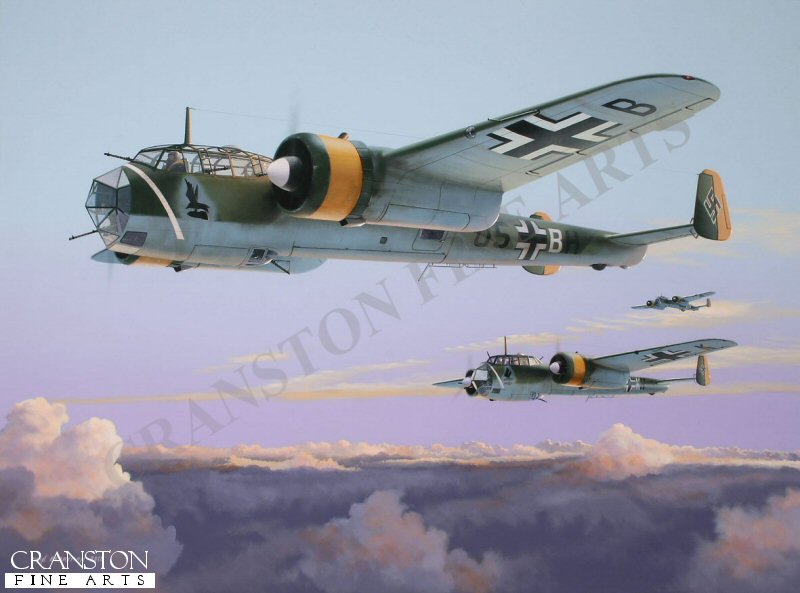
The Ubiquitous Raider - Dornier Do.17s of 1 Gruppe KG2 by Ivan Berryman. Serving in a huge variety of roles throughout WW2, the Dornier Do.17's origins lay in a design for a high speed mail plane capable of carrying six passengers. Numerous developments saw it mature into one of the world's most iconic bombers, typified here by these three Do.17Z-2s of 1 Gruppe, KG 2, based at Tatoi in Greece during 1941. |
DZ 9.00am by Ivan Berryman. A trio of Bell Huey UH-1s deliver ARVN Rangers to a drop zone in the central Highlands of Vietnam during 1970. The ubiquitous Huey saw action in an enormous variety of roles, Vietnam being the first true helicopter war, and it will perhaps be remembered by many a grateful GI for its (and its crews) part in many hundreds of daring rescues amid the unyielding and unfamiliar terrain of south east Asia. |
Mayhem at St Trond by Ivan Berryman. Whilst on a strafing sortie over German occupied St Trond airfield on 25th February 1944, Spitfires of 331 Sqn launched an attack on the Heinkel He.177 bombers that were stationed there. Among those taking part was Norwegian ace Lieutenant Frederick Arild Sverdrup Fearnley, flying Spitfire Mk IX MJ354 (FN-W). Fearnley shared in the destruction of a Heinkel He.177 as it tried to take off, but his Spitfire was immediately hit by ground fire, the young Norwegian losing his life in the ensuing crash. Fearnley was credited with a possible 7 victories in his short career. |
NTG03 - Task Force to Iraq by Ivan Berryman. Key ships of the British task Force sail in close formation in the Mediterranean Sea during the build-up to the coalition liberation of Iraq in march 2003. Ships pictured left to right, include ATS Argus (A135), a Type 42 destroyer in the extreme distance, the flagship HMS ark Royal (RO7), RFA Orangeleaf (A110), LSL Sir Percival (L3036), the Commando and helicopter carrier HMS ocean (L12) and the Type 42 destroyer HMS Liverpool (D92) |
HMS Norfolk at the Battle of the North Cape by Ivan Berryman. HMS Norfolk and HMS Belfast of Force I are shown engaging the Scharnhorst which has already been hit and disabled by both HMS Duke of York and the cruiser HMS Jamaica. Scharnhorst was never to escape the clutches of the British and Norwegian forces for, having been slowed to just a few knots by numerous hits, fell victim to repeated torpedo attacks by the allied cruisers and destroyers that had trapped the German marauder. |
Oberleutnant Godwin Brumowski by Ivan Berryman. Albatros DIII of Godwin Brumowski about to shoot down a Caquot balloon. |
Schumacher by Ivan Berryman. Michael Schumacher in his number one Ferrari at Monza. Now a seven-times world champion, his dominant career will be looked upon as an epic achievement in the future. |
'Dinah Might' Homeward Bound by Ivan Berryman. Tasked with low level bombing operations at the start of Operation Overlord on 6th June 1944, the B-26 Marauders of the 386th Bomb Group, 553rd Bomb Squadron, carried out their missions with great success, softening up the German defenses to pave the way for the Allied landings along the beaches of northern France. Shown here is one such aircraft, 131576 AN-Z, now on display at the Utah Beach Museum. |
Tempest Moon by Ivan Berryman. Three 501 Sqn Hawker Tempests roar low across the North Sea outbound from Bradwell Bay, Essex, on their way to attack a German airfield at Bad Zwischehhan and nearby rail yards on the night of 2nd October 1944. The trio comprised of Sqn Ldr Joseph Berry, flying EJ600 (SD-F), Flt Lt E L 'Willy' Williams (SD-L) and Flt Lt C A 'Horry' Hansen. Berry was to lose his life on this mission, his aircraft being hit by ground fire from soldiers manning a radar station east of Veendam. |
Tribute to Ken Mackenzie by Ivan Berryman. Wing Commander Ken Mackenzie was a formidable opponent during the Battle of Britain - even without any weaponry as on the occasion depicted here. Then a Pilot Officer flying with No.501 Sqn, on 7th October 1940 he shot up an Me109 and followed it down to the sea, expecting it to ditch. When his foe did not crash-land, he used the starboard wing-tip of his Hurricane, V6799 SD-X, to strike the tailplane of his opponent, sending the German fighter crashing into the water. Thus he claimed one of at least 6 victories during the Battle of Britain and 10 overall in the war. Posted in June 1941 to No.247 Sqn, Ken Mackenzie was himself forced to ditch into the sea after damage from flak over Brittany. He became a prisoner of war until October 1944 and served in the Royal Air Force until 1967, becoming an airline pilot until 1973. He died in 2009. |
Kerr's Last Combat by Ivan Berryman. Spitfire L1000 (DW-R) of No.610 Sqn is terminally damaged by an Me109 over Dunkirk on 29th May 1940. The Spitfire pilot, Flying Officer Gerald Kerr is listed is missing after this combat. |
Last of the Luck by Ivan Berryman. Following a violent collision with a Bf.109 over northern France on 9th August 1941, Douglas Bader found himself trapped in the cockpit of his Spitfire, now missing its entire tail, as it plunged toward the ground. Only by releasing one of his artificial legs was he finally able to make his escape, leaving the leg behind. |
Exchange of Fire by Ivan Berryman. A veteran of the Spanish Civil War, Lieutenant Commander Carlo Fecia Conte di Cossato was one of the most successful and formidable Italian submarine commanders of WWII. In charge of the Tazzoli , he destroyed almost 18,000 tons of shipping on his first mission, steadily adding to this total as they prowled the Atlantic. The Tazzoli is depicted as its tenacious crew retaliate with machine gun fire against a marauding Bristol Beaufort of 217 Sqn on 23rd May 1941, an encounter that left both protagonists with some damage. |
HMS Thrasher by Ivan Berryman. A T-Class submarine of the Royal Navy launched in 1940 and commissioned in May 1941, HMS Thrasher famously survived an attack by aircraft in 1942, her crew gaining two Victoria Crosses in the process. Immediately after attacking a supply vessel on 16th February, HMS Thrasher was bombed from the air but escaped unscathed. After resurfacing, two unexploded bombs were discovered within the casing of the submarine. The first was easily removed but the second took a contorted effort in confined spaces - an hour-long combined effort by Lt Roberts and PO Gould literally manhandled the lethal ordnance safely over the side. For actions that likely save the submarine, they were both awarded the Victoria Cross. |
A Busy Day at the Office by Ivan Berryman. The leadership qualities and grim determination of Squadron Leader J R Baldwin was seldom better demonstrated that when he led a small flight of Hawker Typhoons against a force of some thirty Focke-Wulf Fw.190s in January 1944. Nine of the German aircraft were shot down that day, Baldwin himself being responsible for two of them. He is shown here in Typhoon PR-A of No.609 Squadron. |
Out Of The Sun - LFG Roland C.II by Ivan Berryman. One of the few rules of aerial combat that were established in the First World War was to attack, where possible, with the sun behind you, thus using the element of surprise both to appear as if from nowhere and to blind your opponent to minimise retaliation. Just such a tactic has been successfully employed here as a DH.2 rakes the tail of Staffelfuhrer Hauptmann Rudolf Kleines Kasta 3 LFG Roland C.II as it returns from a patrol in the skies above northern France in 1916. Known affectionately as The Whale, the C.II was extensively streamlined and the positioning of the cockpits and wing cut-outs afforded both the pilot and observer unequalled views in all directions. Power was supplied by a 160hp Mercedes D.III engine and armament was a 7.92mm Spandau in front of the pilot and a 7.92mm Parabellum for the observer. |
Dora-Nine by Ivan Berryman. (PC) Without doubt one of the finest fighter aircraft of WW2, the Focke-Wulf FW.190 was steadily developed from the BMW-powered 'A' series through to the Jumo-Powered 'D', the latter of which proved superior to its predecessors in almost every respect. Here, a pair of D-9s of IV./JG3 based at Prenzlau in Eastern Germany, roll through a glorious late afternoon sky in March 1945. |
|
Contact Details |
Sign Up To Our Newsletter!
This website is owned by Cranston Fine Arts. Torwood House, Torwoodhill Road, Rhu, Helensburgh, Scotland, G848LE Contact: Tel: (+44) (0) 1436 820269. Email: cranstonorders -at- outlook.com
|
|